Yesterday, I finally caught up with the rest of the world and saw Borat, 9 years late. Strange experience, viewing it long after it became a high school meme, when fellow school mates (mostly guys) annoyed the hell out of everyone with their repeated exclamations of "very nice, how much!"
And the movie itself was quite funny; had I seen it earlier, I'd probably be one of those quoting idiots (Oh, who am I kidding; I was one of those quoting idiots; it was that prevalent, like how Napoleon Dynamite (2004) was inescapable in Middle School). Again, it was a bit disorienting, see it years after the media hullaballoo that surrounded it: the interviews, the quoting, the infamous bare-ly there swimsuit, and all that suing. Now that the smoke has dissipated, I can now see why it pissed off so many people, including all of Kazakhstan, and was so highly regarded by critics.
The latter is partially due to its humor, and partially because it's a genuinely amusing satire of the Bush Jr. days, when America was very diffidently "fuck ya!" after 9/11. Kinda like Team America: World Police (2004), Borat takes aim at the foibles and ignorance of American Culture, milking laughs from an outrageous outsider's perspective, and showing up snobs and bigots in the process when they partake, intentional or not, in very politically incorrect banter.
Would I rewatch it again? Maybe, if it was on TV; it did make me laugh, after all, despite its dry spells, which is more than many other, longer comedies have done.
In conclusion, I'm glad I finally saw this very funny movie.
Things I found particularly humorous: The very Soviet credits. Borat's commentary during the Kazakhstan scenes. The unsuccessful attempts to get intimate with aggressive and/or fleeing New Yorkers. Successful attempts to party at the gay pride parade (foreshadowing of Brüno)? The nude wrestling. Travels across America with a bear tied up in the back of an ice cream truck, and a chicken stuffed in a suitcase.
Accidentally? Feminist rating: Borat continually objectifies woman to a beyond-absurd degree, but the women themselves come off comparatively well, with the interviewed feminists, Borat's prostitute date, and Pamela Anderson somehow managing to hold onto their dignity.
Sunday, August 9, 2015

Thursday, August 6, 2015
Piccadilly (1929)
One of those impossibly mobile movies from the silent era, right before that free-wheeling aesthetic kicked the bucket with the coming of sound. The camera just cannot sit still; not anchored by sound equipment, it positively floats. It follows, pans and tracks after actors, particularly during three beautifully filmed dance sequences.
Anna May Wong, as Shosho, just trumps everyone in the cast by being her own glam self. She has such presence, the movie just runs out of steam whenever she's not on screen. Quite the famme fatale, her sly smirks and seductive gestures result her being more compelling than her rival Mabel (Gilda Gray).
No fault of Mabel's own, but this blonde dripping with jewelry is a diva. She goes through the old hat routine of being jealous of The OTHER Woman (Shosho), and I ended up rooting for Shosho, who at least puts the moves on the boss subtlety. It doesn't help that, in contrast to Mabel's dumping of boyfriend/boss Mr. Wilmont (James Thomas) and her too-late regret afterwards, that Shosho has a more compelling character arc, going from a British-Chinese dishwasher to the toast of the very white and very rich cliental of The Piccadilly Nightclub.
Alas, if you're familiar with old movies, it comes at no surprise that 1) you don't actually see Shosho kiss her white boss Mr. Wilmont (it cuts right before lip to lip contact), but 2) she gets bumped off. To have a woman of Asian decent sleep with a white man is one thing, but for her to live afterwards would have been too much for 1920s audiences. Still, to even suggest sexual relations between the two (as this movie does) must have been really racy for the time.
I have to wonder how this went over in the US. I'm guessing that the sequence in the low class dive, where a drunk white woman dances with a black man and gets both of them kicked out, must have certainly been cut. The scene is presented without comment: is it pro- or anti-segregation? This is the only time that the movie acknowledges racism openly; jealous Mabel seems more perturbed that a former scullery maid is stealing her spotlight. On the one hand, Shosho seduces her boss, whom she doesn't love (at least, that's what Mabel claims) for monetary benefits, and gets punished for it. On the other hand, Shosho isn't a villain, and we the viewers spend enough time with her, and in her squalid apartment, empathize with her and get caught up in her rise. He amicable relationship with a dumpy white scullery-maid, who encourages Shosho throughout, is quite refreshing.
Also fun:
The neat opening displays the credits on the sides of busses.
Charles Laughton shows up as a fellow who causes a ruckus over a dirty plate.
Caddish Cyril Richard, the fiend who got knifed in Blackmail (1929), shows off his neat dancing skills.
The good: cinematography, Anna May Wong
The Bad: bland white leads, cliche jealousy plot, Ms. Wong's fate
Accidentally Feminist?: Not really, but it's neat to see a successful woman of Asian decent on the silent screen.
Anna May Wong, as Shosho, just trumps everyone in the cast by being her own glam self. She has such presence, the movie just runs out of steam whenever she's not on screen. Quite the famme fatale, her sly smirks and seductive gestures result her being more compelling than her rival Mabel (Gilda Gray).
No fault of Mabel's own, but this blonde dripping with jewelry is a diva. She goes through the old hat routine of being jealous of The OTHER Woman (Shosho), and I ended up rooting for Shosho, who at least puts the moves on the boss subtlety. It doesn't help that, in contrast to Mabel's dumping of boyfriend/boss Mr. Wilmont (James Thomas) and her too-late regret afterwards, that Shosho has a more compelling character arc, going from a British-Chinese dishwasher to the toast of the very white and very rich cliental of The Piccadilly Nightclub.
Alas, if you're familiar with old movies, it comes at no surprise that 1) you don't actually see Shosho kiss her white boss Mr. Wilmont (it cuts right before lip to lip contact), but 2) she gets bumped off. To have a woman of Asian decent sleep with a white man is one thing, but for her to live afterwards would have been too much for 1920s audiences. Still, to even suggest sexual relations between the two (as this movie does) must have been really racy for the time.
I have to wonder how this went over in the US. I'm guessing that the sequence in the low class dive, where a drunk white woman dances with a black man and gets both of them kicked out, must have certainly been cut. The scene is presented without comment: is it pro- or anti-segregation? This is the only time that the movie acknowledges racism openly; jealous Mabel seems more perturbed that a former scullery maid is stealing her spotlight. On the one hand, Shosho seduces her boss, whom she doesn't love (at least, that's what Mabel claims) for monetary benefits, and gets punished for it. On the other hand, Shosho isn't a villain, and we the viewers spend enough time with her, and in her squalid apartment, empathize with her and get caught up in her rise. He amicable relationship with a dumpy white scullery-maid, who encourages Shosho throughout, is quite refreshing.
Also fun:
The neat opening displays the credits on the sides of busses.
Charles Laughton shows up as a fellow who causes a ruckus over a dirty plate.
Caddish Cyril Richard, the fiend who got knifed in Blackmail (1929), shows off his neat dancing skills.
The good: cinematography, Anna May Wong
The Bad: bland white leads, cliche jealousy plot, Ms. Wong's fate
Accidentally Feminist?: Not really, but it's neat to see a successful woman of Asian decent on the silent screen.
Wednesday, March 4, 2015
Lola Montès (1955) & Dr. No (1962)
Lola Montès is a biopic about the titular 19th century Courtesan, a living prop in a circus show about her life. Throughout the show, during the Ring Master's (the always dynamic Peter Ustinov) exposition, Lola (Martine Carol) flashbacks to her past life and loves, when things where easier, the cigars plentiful, and her lovers rich, famous, and easy to break up with.
This movie is crazy colorful, with vivid reds, blues, and yellows that you just don't seen any more on film, and expensively elaborate, with puffy costumes fringed with sequins and a carriage big enough to hold a piano. I don't see why critics are so disdainful towards Ms. Carol; I thought she was fine, not great, mind you, but perfectly fine; she didn't stand out as being particularly dull or flagrantly artificial, like the worst actresses I've seen. The other actors were admittedly superior, especially Anton Walbrook--always nice to see him play a nice guy, in this case King Leopold I of Bavaria. Jules (Oskar Werner) from Jules and Jim (1962) also shows up as a smitten student.
I really need to see more Ophüls movies; thus far, the only things I've seen by him are Letter From an Unknown Women (1948), Caught (1949), and La Ronde (1950). All of those are great, highly enjoyable and aesthetically jaw-dropping (well, Caught was a bit underwhelming, but it did have its moments), so this needs to be corrected. Eventually. Can't understand why this movie was originally reedited to make it more "chronological"; did the studio really think that audiences wouldn't be able to follow the plot? Then again, the similarly timeline jumping Intolerance (1916) didn't do that well financially either, and it's a hands down classic!
Now for Dr. No, where the world first saw Bond, James Bond, on screen, the big screen, that is. Technically, his debut came on TV, in an hour-long adaptation of Casino Royale (1954) on the anthology show Climax!; he was dubbed Jimmy Bond, and was American. I wonder if one can see it.
But to the point; Dr. No already sets up much of what we know and love about Bond: his fancy suits, his "shaken not stirred" dry martinis, his bedding (or boating, at one point) of multiple beautiful women, and his usage of his license to kill. Unfortunately, his fear of tarantulas were not further elaborated on. And there are no nifty gadgets here: a gun is traded in for another gun, and that's it. Good to see that the movie already offered eye candy for all the folks in the audience, with bikini babes, in addition to Bond being shirtless a lot.
It's also surprisingly brutal, for a Bond film: James bosses around women and grabs them forcefully, and when people get shot, it looks like they got dabbed with some fake blood swiped from Hammer Studios. There's also an unfortunate black stereotype (John Kitzmiller) who's afraid of dragons and ends up getting fried by the baddies.
This movie is crazy colorful, with vivid reds, blues, and yellows that you just don't seen any more on film, and expensively elaborate, with puffy costumes fringed with sequins and a carriage big enough to hold a piano. I don't see why critics are so disdainful towards Ms. Carol; I thought she was fine, not great, mind you, but perfectly fine; she didn't stand out as being particularly dull or flagrantly artificial, like the worst actresses I've seen. The other actors were admittedly superior, especially Anton Walbrook--always nice to see him play a nice guy, in this case King Leopold I of Bavaria. Jules (Oskar Werner) from Jules and Jim (1962) also shows up as a smitten student.
I really need to see more Ophüls movies; thus far, the only things I've seen by him are Letter From an Unknown Women (1948), Caught (1949), and La Ronde (1950). All of those are great, highly enjoyable and aesthetically jaw-dropping (well, Caught was a bit underwhelming, but it did have its moments), so this needs to be corrected. Eventually. Can't understand why this movie was originally reedited to make it more "chronological"; did the studio really think that audiences wouldn't be able to follow the plot? Then again, the similarly timeline jumping Intolerance (1916) didn't do that well financially either, and it's a hands down classic!
Now for Dr. No, where the world first saw Bond, James Bond, on screen, the big screen, that is. Technically, his debut came on TV, in an hour-long adaptation of Casino Royale (1954) on the anthology show Climax!; he was dubbed Jimmy Bond, and was American. I wonder if one can see it.
But to the point; Dr. No already sets up much of what we know and love about Bond: his fancy suits, his "shaken not stirred" dry martinis, his bedding (or boating, at one point) of multiple beautiful women, and his usage of his license to kill. Unfortunately, his fear of tarantulas were not further elaborated on. And there are no nifty gadgets here: a gun is traded in for another gun, and that's it. Good to see that the movie already offered eye candy for all the folks in the audience, with bikini babes, in addition to Bond being shirtless a lot.
It's also surprisingly brutal, for a Bond film: James bosses around women and grabs them forcefully, and when people get shot, it looks like they got dabbed with some fake blood swiped from Hammer Studios. There's also an unfortunate black stereotype (John Kitzmiller) who's afraid of dragons and ends up getting fried by the baddies.
And there's yellowface, which is unfortunately and awkwardly, a very common element in older movies. The though process must have been: "Hey, why hire an Asian when we can just hire a white dude to play one? Genius!" A quick scan of the "Examples of Yellowface" article on Wikipedia show that this tendency has continued. I know it was the early 60s, and Joseph Wiseman's subtle Dr. No is less wincing than Alec Guinness having difficulty saying "lollypop" as a Japanese widower in A Majority of One (1962). But it's weird, and slightly disconcerting, that he Bond franchise, long may it live, has prospered because of the success of a film that has metal-handed Fu Manchu whom threatens the world with nuclear yellow terror?
And yet, I still like this movie. Because, damn it, I'm only human, and Sean Connery's Bond is so cool; even when he sang, and I got Darby O'Gill and the Little People (1959) flashbacks (which isn't necessarily a bad thing, because Darby O'Gill is among Disney's best live action films). Plus, Jamaica locations, that gun-barrel opening, and that goddamn awesome theme song, the latter which ISN'T written by John Barry, to my disillusionment that John Barry.
Lola Montès and Dr. No are very much preoccupied with gazing: men looking at women, and women, in turn, looking at men. Because of gender dynamics, and in the tradition of fictional "loose women," Lola ends up punished for her indiscretions though, to the movie's credit, she isn't condemned for her actions; the most unsympathetic characters are those that use her for their own ends: the mother who tries to marry her off to an old rich nobleman, her cheating drunk of a husband, the Bulvarian revolutionaries who make her a scapegoat, and, ultimately, the coin-counting circus owner who exploits her fame for his financial gain. On the other hand, Bond, because he's all manly, never gets any sort of punishment or comeuppance for his numerous sexcapades. But isn't that just the way of movies in a patriarchal society?
And yet, I still like this movie. Because, damn it, I'm only human, and Sean Connery's Bond is so cool; even when he sang, and I got Darby O'Gill and the Little People (1959) flashbacks (which isn't necessarily a bad thing, because Darby O'Gill is among Disney's best live action films). Plus, Jamaica locations, that gun-barrel opening, and that goddamn awesome theme song, the latter which ISN'T written by John Barry, to my disillusionment that John Barry.
Lola Montès and Dr. No are very much preoccupied with gazing: men looking at women, and women, in turn, looking at men. Because of gender dynamics, and in the tradition of fictional "loose women," Lola ends up punished for her indiscretions though, to the movie's credit, she isn't condemned for her actions; the most unsympathetic characters are those that use her for their own ends: the mother who tries to marry her off to an old rich nobleman, her cheating drunk of a husband, the Bulvarian revolutionaries who make her a scapegoat, and, ultimately, the coin-counting circus owner who exploits her fame for his financial gain. On the other hand, Bond, because he's all manly, never gets any sort of punishment or comeuppance for his numerous sexcapades. But isn't that just the way of movies in a patriarchal society?
Tuesday, March 3, 2015
Gladiator (2000)
Though slow in spots, good action scenes mean that Ridley Scott managed to create one last iconic movie before the inevitable critical decline. The beginning is a special kind of slog, all blue tinting with occasional spurts of yellow flame in a battle scene which's a tiny bit on the dull side; I blame lack of stakes so early in the game (another rebellion the Roman Empire needs to put down); then again, the only purpose of this fight is to demonstrate what a popular guy and great tactician Maximus (Russell Crowe) is. Things don't get any more compelling with the entrance of Emperor Richard Harris, who expositions with anyone he comes into contact with, including his daughter Lucilla (Connie Nielsen), Crowe, and son Commodus (Joaquin Phoenix); the latter proves himself a bad apple when he bumps off pop and blames Crowe.
Being a farmer, which means that he's a nice, incorruptible guy, Crowe escapes execution to save his wife and son, who he LOVES VERY MUCH. This doesn't bode well with this type of movie, and following following the sacred movie law of killing off the hero's dearies to provide him motivation to get all medieval on the asses of his enemies, they are brutally murdered.
Somehow, Crowe is found, and is taken to the desert with Juba (Djimon Hounsou), a Black actor who'd be whitty's sidekick again in Blood Diamond (2006) No complaints about him , or really any of the actors here, because he's really good and has a ton of presence, and outlives many of the white characters when the credits roll (the last time I saw that in a sword/sandals film was, what, Demetrius and the Gladiators (1954)?)
Crowe and Hounsou become buddies, and they get bought by Gladiator trainer to Oliver Reed, whose presence automatically raised my interest 20%; he died during the making of this film, but it's nice that his last movie was something so uncharacteristically classy and high budget.
And with his appearance, plus the tinting change from blue to brownish tan (because desert), the movie gets a whole lot more compelling, because the action needs to fit the title, so Crowe becomes a GLADIATOR!!! Being a general, he's really good at killing people. Meanwhile, in the still-impressive CGI, gray-tinted landscapes of Rome, Joaquin really takes to the role of emperor, toying with dealing the incest card with his very NOT receptive sister. She's in love with Crowe, but thankfully is very subdued: less swooney and more repressed attraction. She also actively tries to help Crowe, and gets to show all sorts of worried faces as she tries to protect her son (and future Emperor) from eeeeeeevil Joaquin.
Meanwhile, as Crowe becomes a superstar and creates a meme ("Are you not ENTERTAINED?!") We find out that Crowe has a method behind his consistent killing: he wants to be so good and popular, that the Emperor will go down to meet him, and Crowe can kill him. Sounds like a good plan, but considering how much longer we have to go, it's not gonna work. We need complications, dun dun dun. Which include tigers, Germans, and I Claudius (Derek Jacobi) showing up.
Won't lie, this is chockfull of cliches, but this is made up with surprisingly compelling characters and action sequences, which are a bit over-edited, but very comprehensible, thank God, all of which results in a genuinely moving ending. Additionally, Though this is a sausagefest of full of men fighting and killing other men (mostly white), it was nice to see some Black women gladiators show up in the carthage battle, throwing spears. They end up dying in brutal ways, like their male cohorts, so equal opportunities? Other than that, not really any other signs of female fighters; there's only one major woman character (and she's the only one to have any lines) and that's the sister. I hope that a movie is eventually made about a female gladiator, preferably with no involvement of gratuitous nudity).
To kinda change the topic, I wonder how many other films there are that follow the "dead family/loved ones as motivation" cliche? Off the top of my head, I can think of Death Wish (1974), Mad Max (1979), The Punisher films, and the gender-fliped The Brave One (2007), but there are definitely others. Here, the doomed family is only seen briefly, which I can't really complain of, because had there been more scenes with them, then this movie would've ran way over 2 1/2 hours. But at the same time, this is downgrading characters down to them only existing so that the hero can have proper motivation to be Mad Maximus. But ultimately, it didn't prevent me from getting emotional during the death scene, so go figure.
Tuesday, July 8, 2014
The Fly (1958)
While I'm on the subject of scary movies, I have to reveal the only film that ever kept me wide awake. The Fly, the old one, not the Cronenberg gross-out fest that is way more intelligent that it should have been. I mean the one with Vincent Price, which also was way more mature and intelligent than it should have been.

I was rather young, about ten years old. I was intrigued about The Fly after seeing a Simpsons "Treehouse of Horror episode" which homaged it (including the web scene, more on that later) My parents, absolutely underestimating my sensitivity to anything remotely frightening, thought my repeated vocal worries about the subject matter were entirely unfounded. Yeah, right. To be fair, they hadn't seen the film either, so how were they to know that this cheesy sci fi film could possibly terrify a child who hid behind the sofa whenever she heard the Psycho theme?


So, if that poster at the beginning of the post didn't already give it away, after the scientist with a fly's head ends up getting destroyed by his wife, the fly with the scientist's head is still free. That is, until the scientist's son finds it stuck in a web, and the audience is treated to a 1-2-3 punch of shock:
1- The Voice. Before we get a chance to see anything clearly, we hear that voice. That ungodly high pitched voice, so tiny that it's indistinguishable from a fly's buzzing. It's the scientist, crying out in primal pathetic tones. "Help me! Help me!" And it's coming from the middle of a spider web.
2- The Spider. When we finally get a close-up on the fly/scientist crossover, we are mistreated to the grotesque sight of a bald, toothless human head on a fly's body, wrapped up in spider silk, its lone human arm sticking out helplessly as a gigantic spider looms over him. The Magic School Bus taught me long ago what was going on, and what the impending fate of the fly would be.
3- The Rock. Just as the fly completely covers up its victim, and the fly/scientist gives a spine-chilling scream of fear, Inspector Herbert Marshall, viewing the scene with Vincent Price (ah, 50s casting), grabs a rock and slams it down on the spider, effectively killing it and the fly creature.
So, in simple math, when you add 1.screeching, primal voice of the fly/scientist + 2. horrifying visuals of snarement + 3. a sudden, brutal conclusion to a scientist's wayward experiments, you = 1 absolutely terrified 10 year old.
I know I eventually feel asleep that night, but it took a very long time. I distinctly remember that my leg could not stop twitching, that was how edgy I felt. Even after such jumpers as The Haunting (1963) and Insidious, I can still get a good night's sleep. But even know, if I come across a scene from a certain 50s sci-fi film that took a silly concept and turned it into a tragedy of regressive humanity, subconsciously I can't hold back a shiver.
I was rather young, about ten years old. I was intrigued about The Fly after seeing a Simpsons "Treehouse of Horror episode" which homaged it (including the web scene, more on that later) My parents, absolutely underestimating my sensitivity to anything remotely frightening, thought my repeated vocal worries about the subject matter were entirely unfounded. Yeah, right. To be fair, they hadn't seen the film either, so how were they to know that this cheesy sci fi film could possibly terrify a child who hid behind the sofa whenever she heard the Psycho theme?
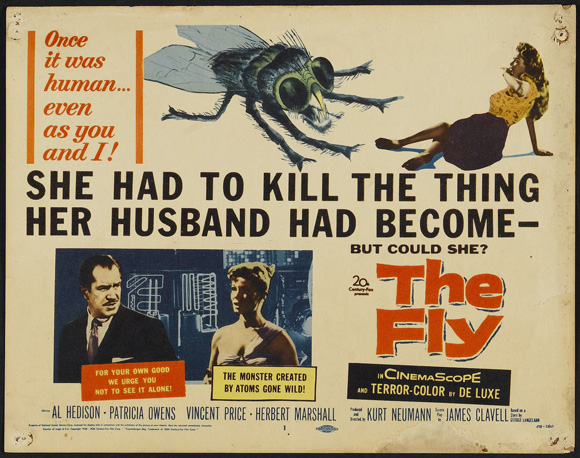
Admittedly, the first half of the film is rather tame, though it does contain an extremely effective build-up to the inevitable monster of the title. Those who have seen the film know what I'm talking about. The reveal was frightening enough, when the wife pulls back the black cloth over her transformed husband's head only to reveal that dreaded fly's head, her screams reflected in its multiple eyes. That was enough to send me running up the stairs, and I wouldn't come down again until my parents exasperatedly shouted up the stairs that the "scary part" was over. Foolishly, I believed them, and went down, aware what was going to happen, but underestimating its impact.
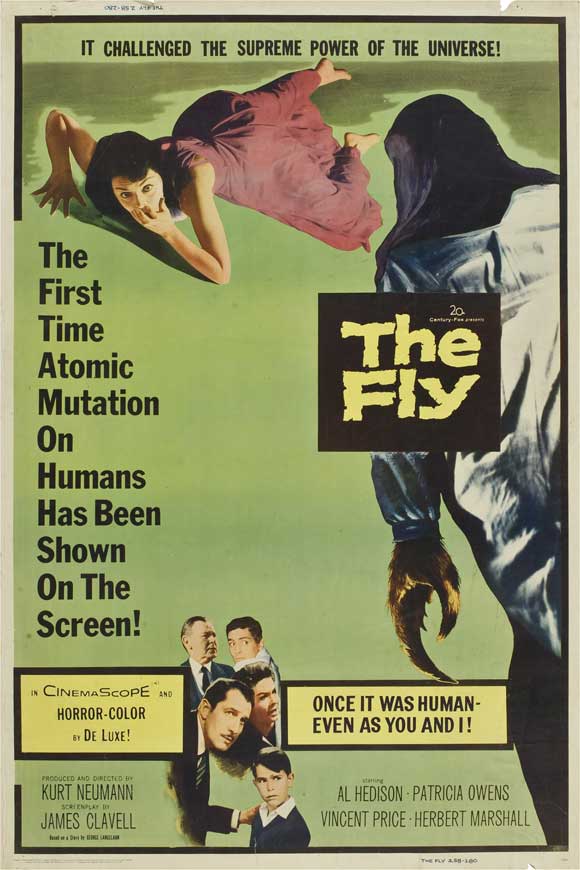
So, if that poster at the beginning of the post didn't already give it away, after the scientist with a fly's head ends up getting destroyed by his wife, the fly with the scientist's head is still free. That is, until the scientist's son finds it stuck in a web, and the audience is treated to a 1-2-3 punch of shock:
1- The Voice. Before we get a chance to see anything clearly, we hear that voice. That ungodly high pitched voice, so tiny that it's indistinguishable from a fly's buzzing. It's the scientist, crying out in primal pathetic tones. "Help me! Help me!" And it's coming from the middle of a spider web.
2- The Spider. When we finally get a close-up on the fly/scientist crossover, we are mistreated to the grotesque sight of a bald, toothless human head on a fly's body, wrapped up in spider silk, its lone human arm sticking out helplessly as a gigantic spider looms over him. The Magic School Bus taught me long ago what was going on, and what the impending fate of the fly would be.
3- The Rock. Just as the fly completely covers up its victim, and the fly/scientist gives a spine-chilling scream of fear, Inspector Herbert Marshall, viewing the scene with Vincent Price (ah, 50s casting), grabs a rock and slams it down on the spider, effectively killing it and the fly creature.
So, in simple math, when you add 1.screeching, primal voice of the fly/scientist + 2. horrifying visuals of snarement + 3. a sudden, brutal conclusion to a scientist's wayward experiments, you = 1 absolutely terrified 10 year old.
I know I eventually feel asleep that night, but it took a very long time. I distinctly remember that my leg could not stop twitching, that was how edgy I felt. Even after such jumpers as The Haunting (1963) and Insidious, I can still get a good night's sleep. But even know, if I come across a scene from a certain 50s sci-fi film that took a silly concept and turned it into a tragedy of regressive humanity, subconsciously I can't hold back a shiver.
Sunday, July 6, 2014
[Rec] (2007)
An example of how viewing environment affects movie watching:
A few months ago, A friend and I watched the great Spanish horror movie [Rec] in his dorm room. The clever use of found footage, combined with the increasing claustrophobia and whammy of an ending, resulted in both us being quite shaky when it finished. He felt fine, but since I lived across campus, I was really nervous about taking that 10 minute journey alone.

However, my nervousness was unjustified, because if there was anything that could relieve one of the confining terrors seen on screen, it was a nice cool walk in the outdoors; I got home fine and ended up sleeping without a problem. So who ended up staying awake until 3 am? That's right, my buddy, who freaked out his roommate by remaining wide awake at that late hour, peeking out from under the covers.
A few months ago, A friend and I watched the great Spanish horror movie [Rec] in his dorm room. The clever use of found footage, combined with the increasing claustrophobia and whammy of an ending, resulted in both us being quite shaky when it finished. He felt fine, but since I lived across campus, I was really nervous about taking that 10 minute journey alone.
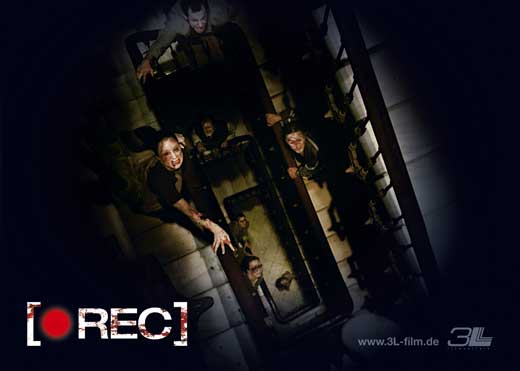
Look at this! Wouldn't you be terrified as well? Source
However, my nervousness was unjustified, because if there was anything that could relieve one of the confining terrors seen on screen, it was a nice cool walk in the outdoors; I got home fine and ended up sleeping without a problem. So who ended up staying awake until 3 am? That's right, my buddy, who freaked out his roommate by remaining wide awake at that late hour, peeking out from under the covers.
Tuesday, July 1, 2014
The Mark of the Vampire (1935)

Tod Browning and Bela Lugosi's post-Dracula vampire reunion film is a nice atmospheric Universal horror film with plenty of low hanging fog and giant spiderwebs, all within a giant castle, of course. It also contains one heck of woman vampire.

That's Luna (Carroll Borland), and she's supposed to be the daughter of Count Dracula, d'I mean, Count Mora. While the main plot, which has something to do with Lionel Barrymore investigating a murder, is doing its own thing, Mora and Luna are wandering around their castle, looking ever so classily spooky.


Luna is a wonderfully designed creation. While Lugosi repeats his vampire garb of suit and cape, reminiscent of the 19th century, Luna looks like she comes from a more ambiguous time period. Her dress with train is reminiscent of the vampire brides that haunted Dracula's castle in the earlier film, but the lack of ornamentation on her modest, long sleeved gown, long hair, and striking make-up gives her the appearance of a more modern, yet ageless type of vampire. I have read theories that her look was an inspiration for the appearance of Lily Munster, which isn't too far-fetched.

Besides her appearance, Luna, as far as I know, is not only one of the earliest examples of a cinematic vampire who happens to be a woman, but also is one of the first seen (or more accurately, implied) to actually bite a person. I hesitate to say first, because this film is a remake of an earlier Tod Browning silent, London After Midnight (1927), one of the most famous lost films of all time. Judging from the "reconstruction" (actually just a bunch of promotional stills tied together with inter titles), the woman vampire in that film also attacked the good (ie forgettable) heroine.

Given what few scenes she has, Luna manages to hold attention in those moments with her otherworldly appearance: the way her dress spreads like wings when she attacks:

Or her slow decent with actual bat wings, a true way to enter in style.


While hesitant in calling her a rebel, there is something gratifying in seeing a lady vampire joins the Dracula club in neck bitting and transformation; it's how she separates herself from the previous vampire brides. She is a daughter, defining herself outside of a parent, no longer just a passive follower of her authority figure willing to slink off at the first glint of disapproval. Though she still follows orders, she manages to make do on her own, all the while staring eerily with the best of the bloodsuckers.

(Spoilers) Even the revelation that she and her "father" are no more than actors, hired by Detective Lionel Barrymore to...accomplish something relevant to the case, I think.... doesn't deter Luna from being cool. It's here that the audience is finally given a chance to see her without make-up, and smiling. Remaining mute throughout much of the film, she is finally given a voice, and a snarky one at that. Responding to the Count's pompus declaration that he "was better than any REAL vampire", she says "Sure, sure, but get off your make-up", followed by "And help me with some of this packing" (referring to their trucks of props, including those gorgeous wings). Her grounded demeanor is a refreshing break from the somber, hysterical ladies that so often populate this Universal horror movies; she's had her fun, but is ready to move on with her life, like a true professional performer.

Even as a mortal, she still is her own woman, one who is no-nonsense and not defined by her more famous co-star. It's beyond appropriate, after being placed in a consistent position of subservience, we last see Luna giving that man who played her father orders.

Subscribe to:
Posts (Atom)