In the otherwise sloggy and unmemorable biopic Alexander the Great, which I saw about a year ago, and staring everyone's favorite glowering Welshman Richard Burton (who, according to Look Back in Anger (1959), "knows what it's like to be angry. ANGRY!"), two moments remain stuck in my mind:
1. The scene where a very bearded Fredric March, playing Alexander's dad Philip, does a drunken dance on a hill overlooking the camp.
2. The part where Buuuurton gets into a brief kurfuffle with fellow Welsh actor Stanley Baker. Later, the two would be kinda sorta reunited in the top-notch Zulu (1964), with Baker staring and Burton providing narration.
Other than that, the rest of the movie completely escapes my memory. Except Burton's blonde wig; that thing was the one truly golden object in a nearly 2 1/2 hour checklist of Important Moments in Alexander's Life. Almost makes me want to check out Oliver Stone's lambasted attempt to frame this grandiose historical figure, for comparison's sake. Almost.
Showing posts with label Fredric March. Show all posts
Showing posts with label Fredric March. Show all posts
Friday, March 25, 2016

Wednesday, March 26, 2014
I Married a Witch (1942)
In Puritan times, a witch and her father are burned at the stake in a New England town. Before her execution, however, the witch placed a spell on Johnathan Wooley (Fredric March), the man who accused her, cursing him and all his decedents to be stuck in miserable marriages. Fast-forward to the present, and the newest Wooley (again Fredric March) is running for governor and is due to be married to a shrewish woman (Susan Hayward) the next day. As (bad) luck would have it, the witch is resurrected in the form of Veronica Lake, and she plans to continue messing with the Wooley family by having March fall in love with her.
I have a special nostalgic place in my heart for this movie. It was one of the first old films I ever watched multiple times as a child, and it was my introduction to director René Clair and stars Veronica Lake and Fredric March, the latter who has and will always be one of my favorite actors. Therefore, it's completely reasonable that I should herald this film as an under-seen comedic masterpiece. Which it is. It's funny, charming, witty, well-acted, smartly filmed, and contains some marvelous special effects for the time. What more can I say?
Well, Lake gives one of her best performances as the witch of the title, being at times beguiling, conniving, and a little goofy. She pouts when things don't go as planned, but recovers herself by sliding up a banister in order to give March a love potion. March himself is also enjoyable, trying unsuccessfully to hide his attraction to Lake through briskness, only for his voice to squeak whenever she gives him reason to panic. Together they make a cute pair; I'm particularly fond of the sequence when March spends literally all night explaining to Lake why she can't be in love with him, only to end up stroking her hair and laughing at her gobble up his breakfast waffles.
Director René Clair was a master craftsman when it came to moviemaking, and despite being overshadowed by his earlier and more well-regarded French musicals (Le Million for example), I Married a Witch is just as visually stunning as its predecessors. The special effects are deceptively simple, with miniatures, wires, and plenty of smoke to go around. Lake's costumes, designed by Edith Head are gorgeous. And the comedic sequences are golden, especially March's chaotic wedding to Hayward, which is continually interrupted, at first by Lake and her devious spell casting father (Cecil Kellaway), then by March as Lake's influences take their toll on him.
The total effect is nothing short of hilarious; it's the type of film that not only leaves you smiling and maybe a little moved, but will also prevent you from hearing the song "I Love You Truly" the same way ever again.
I have a special nostalgic place in my heart for this movie. It was one of the first old films I ever watched multiple times as a child, and it was my introduction to director René Clair and stars Veronica Lake and Fredric March, the latter who has and will always be one of my favorite actors. Therefore, it's completely reasonable that I should herald this film as an under-seen comedic masterpiece. Which it is. It's funny, charming, witty, well-acted, smartly filmed, and contains some marvelous special effects for the time. What more can I say?
Well, Lake gives one of her best performances as the witch of the title, being at times beguiling, conniving, and a little goofy. She pouts when things don't go as planned, but recovers herself by sliding up a banister in order to give March a love potion. March himself is also enjoyable, trying unsuccessfully to hide his attraction to Lake through briskness, only for his voice to squeak whenever she gives him reason to panic. Together they make a cute pair; I'm particularly fond of the sequence when March spends literally all night explaining to Lake why she can't be in love with him, only to end up stroking her hair and laughing at her gobble up his breakfast waffles.
Director René Clair was a master craftsman when it came to moviemaking, and despite being overshadowed by his earlier and more well-regarded French musicals (Le Million for example), I Married a Witch is just as visually stunning as its predecessors. The special effects are deceptively simple, with miniatures, wires, and plenty of smoke to go around. Lake's costumes, designed by Edith Head are gorgeous. And the comedic sequences are golden, especially March's chaotic wedding to Hayward, which is continually interrupted, at first by Lake and her devious spell casting father (Cecil Kellaway), then by March as Lake's influences take their toll on him.
The total effect is nothing short of hilarious; it's the type of film that not only leaves you smiling and maybe a little moved, but will also prevent you from hearing the song "I Love You Truly" the same way ever again.
Thursday, June 13, 2013
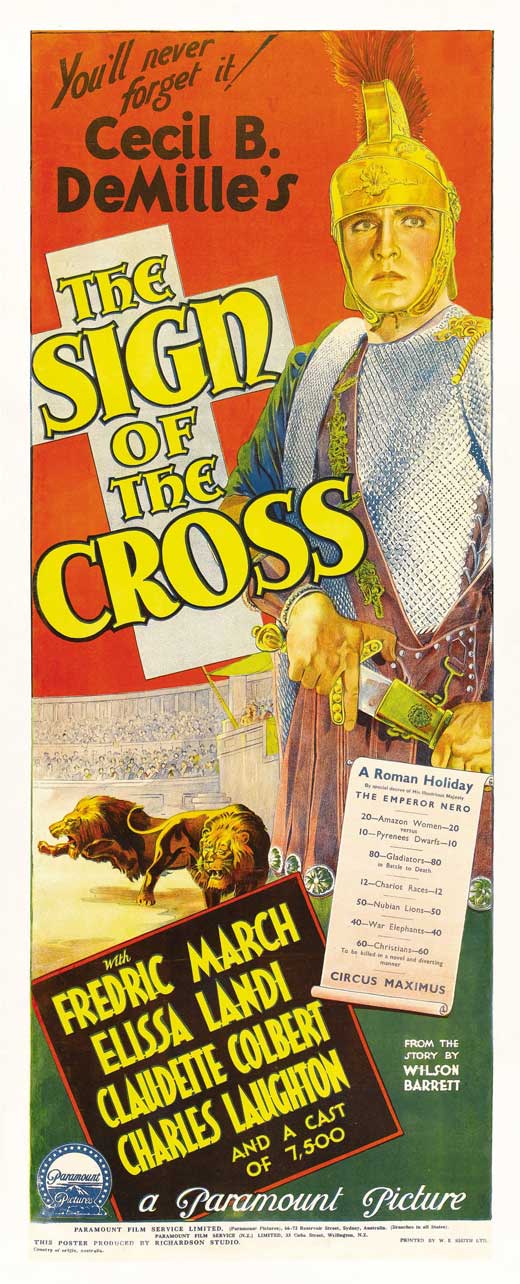
The Sign of the Cross (1932)
_01.jpg)
via doctormacro
On the one hand, you have the Christians, or Xians if you want to be more extreme. They seem nice enough people, young and old, a bit bellow the poverty line; all they really want to do is hang out together in secret meetings to sing the praises of peace, love, and Jesus. Then along comes the pesky intolerant Romans, who shoot arrows at the worshippers and send them to the colosseum. There, they face being squished by elephants or eaten by crocodiles and lions, in between the acts involving boxing, gladiators and women battling pigmies.
The pagan Roman nobles, which populate this film, by comparison, have it great! Parties all the time, all the grapes one can gobble, with more sexy bisexual prostitutes than you can shake a stick at (all right, you only see one, but there has to more out there in ancient Rome). Add Claudette Colbert (as Nero's horny wife Pomepea) bathing in the milk of donkeys, and you know that they are always having a grand old time.
_03.jpg)
via doctormacro
Why the film's hero, Prefect Marcus Superbus (Fredric March, looking very superb in a short tunic and perm), should convert in the end and join his pious Xian girlfriend (Elissa Landi) in being lion chow, is a little perplexing. He enjoys having fun with his fellow Romans, enjoying life and not giving a damn what the next day will bring. In comparison to that, the Xians are the ultimate party poopers, preferring to talk of salvation and not partake in more sinful delights.
So After spending more than 2 hours seeing him having a ball chilling with his pagan pals and getting chummy with Colbert, it's a bit of a shock for him to give it all up to convert literally minutes before the fateful gate opens. Then again, in addition to having an admittedly to a cute uplifting final shot, the entire film is supported by lovely decor and costumes, and populated by the always enjoyable March, Colbert, and Laughton, I carry more praise than disinterest towards it.
While I doubt that the film ever succeeded in converting anyone besides Marcus Superbus, it sure as hell provides a good, pre-code, sometimes head-straching entertainment.
Thursday, June 6, 2013
The Eagle and the Hawk (1933)
The early 30's were a good time for World War 1 flix: All Quiet on the Western Front (1930), and Journey's End (1930) showed that war was hell in the trenches, while Hell's Angels (1930), The Dawn Patrol (1930), and today's film take to the air to get their messages across. The latter type of films also had the added bonus of lacking the explicit gore and grungy claustrophobia of it's ground-based counterparts, making sure to intersperse the somber musings with thrilling areal dogfights.
This conflict of interest, to paint a despairing portrait of wartime, while at the same time providing entertainment, figures heavily into the plot of the unfortunately little-known The Eagle and the Hawk. Polo-playing Jerry Young (Fredric March) and working-man Henry Crocker (Cary Grant) are flyboys in France, whose missions consist of taking pictures of enemy areas, and attempting to evade enemy aircraft. While cynical Crocker remains grouchely somber about the whole affair, Young's naive idealism is unable to handle the brutality that surrounds him.
Though he is a talented flyer, he quickly losses a number of tailgunners in a short period of time. When Crocker becomes his newest replacement, the cleft-chins butt heads. But as Grant keeps his head, March slowly breaks from the strain of having his gunners drop like flies. who becomes something of a hero after flying numerous successful missions, slowly breaks from the strain
With a running time that's a little under 70 minutes, there is little time for padding, including romantic liaisons. A glitzy Carole Lombard, drowning in the fur collar of her coat, shows up for about 5 minutes as an understanding woman March meets on leave. She's okay, but it's March and Grant who are really stellar. While the mean-streaks and the hardheadedness of his character may put off some fans, his grudgingly growing mothering devotion to March reveal a more empathetic interior. Heck, I found him to have more chemistry with the leading man than with some of his leading ladies!

March, on the other hand, has a more obviously showy role as the solider growing in depression and desperation. He manages, as usual, to pull it off with great panache, managing to contain his despair enough to function, but not enough to allow him to move onward from his feelings of guilt and inadequacy when it comes to the death of his men. Overtime, however, he is unable to even accomplish that, leading up to a confessional dinner scene that is a bit reminiscent of his drunken.
The strangely affecting bromance between the doomed hero that can barely keep himself together and the forgotten man who's too aware of that is just one of the many moving aspects of this film. The gorgeous cinematography, well-paced story, and great performances from the leads render this to be a near-great ant-war movie.
This conflict of interest, to paint a despairing portrait of wartime, while at the same time providing entertainment, figures heavily into the plot of the unfortunately little-known The Eagle and the Hawk. Polo-playing Jerry Young (Fredric March) and working-man Henry Crocker (Cary Grant) are flyboys in France, whose missions consist of taking pictures of enemy areas, and attempting to evade enemy aircraft. While cynical Crocker remains grouchely somber about the whole affair, Young's naive idealism is unable to handle the brutality that surrounds him.
Though he is a talented flyer, he quickly losses a number of tailgunners in a short period of time. When Crocker becomes his newest replacement, the cleft-chins butt heads. But as Grant keeps his head, March slowly breaks from the strain of having his gunners drop like flies. who becomes something of a hero after flying numerous successful missions, slowly breaks from the strain
With a running time that's a little under 70 minutes, there is little time for padding, including romantic liaisons. A glitzy Carole Lombard, drowning in the fur collar of her coat, shows up for about 5 minutes as an understanding woman March meets on leave. She's okay, but it's March and Grant who are really stellar. While the mean-streaks and the hardheadedness of his character may put off some fans, his grudgingly growing mothering devotion to March reveal a more empathetic interior. Heck, I found him to have more chemistry with the leading man than with some of his leading ladies!
Decieteful VHS cover art: Lombard shares the box with Grant, and with no March in sight, makes it seem that there will be a love story involved (ala Wings or Hell's Angels)
The strangely affecting bromance between the doomed hero that can barely keep himself together and the forgotten man who's too aware of that is just one of the many moving aspects of this film. The gorgeous cinematography, well-paced story, and great performances from the leads render this to be a near-great ant-war movie.
Saturday, March 26, 2011
The Wild Party (1929)

Oh, dear, old Fredric March, how I love thee. It seems only yesterday (though it was many years ago), that I first saw you getting woed by the bewitching Veronica Lake in I Married a Witch. Since then, I have continued to see you in varied roles in so many movies that I love: Seven Days in May, A Star is Born, Dr. Jekyll and Mr. Hyde, etc. etc. To me, you will always be the best Norman Maine, the best Dr. Jekyll/Mr. Hyde, and the best ancient Roman prefect (I will get back to review you, Sign of the Cross, mark my words).

But before he was cavorting about ancient Rome in a short tunic and a perm, Mr. March was trying to teach flirtatious females college students about Anthropology. I am of course referring to one of his first staring role, the 20's time capsule that is The Wild Party.

And, boy oh boy is this a product of the Roaring Twenties. There is the Carleston, a speakeasy, never-ending innuendo, and, of course, flappers. And the most flappin' of the flappers is none other that Clara Bow, the "real star" of the picture.

She is a happy-go-lucky student who is popular but a bit on the wild side. She mets cute with the new professor (March's role) on a train, and has a romance with him. Add in a subplot about her studious best friend who is working hard for a scholarship, and you have the film in a nut shell.

Now, considering her well-known mike fright, Ms. Bow was not half bad. She had a kind of natural perkiness and warmth that was really quite charming. Alas, March is rather dull and does not leave much of an impression, with the exception perhaps of his mustache.

But is this a good movie? Well..... it is a product of its time: remeber when the main reason girls went to college was to party and to find a nice guy to settle down with? This is a really early talkie, so the shots are static and the dialogue is very stilted. I have to give the film kudos, however, for presenting the best friend as an attractive, intelligent girl who is dedicated to her education, but does not let that prevent her from having some fun.

Also worth noting is that this film is a product of Dorothy Arzner, who was a rare successful woman director of the Studio system. I have only previously seen two of her films, Dance, Girl Dance and Merrily We Go to Hell (1932, again with Fredric March), but I plan on seeing more.

Though not necessary viewing, I think that this film is worth a look if you a fan of either star, early talkies, or a cinematic portrait of the "wild party" of the Twenties just before the hangover of the Depression.

Subscribe to:
Posts (Atom)