I found the original to be superfluous, but harmless. The lead actors and cinematography were gorgeous, but the movie as a whole was a rather bland affair, half-heartedly attempting to appear deeper than the soapy fluff it was. Its new iteration tries to avoid that trap by inserting flashbacks and food porn, but alas, falls into the same hole. To the movie's credit, Swinton and Fiennes are a lot of fun to watch. But I did want it to improve on the source material, instead of matching it, so I can't help but be a wee bit disappointed.
Showing posts with label review. Show all posts
Showing posts with label review. Show all posts
Thursday, June 2, 2016
A Bigger Splash (2015)
So La Piscine (1969) got a remake. They switched the location from France to Italy, replaced Romy Schneider, Alain Delon and Maurice Ronet with Tilda Swinton, Matthias Schoenaerts, and Ralph Fiennes, and sprinkled in a killer soundtrack ranging from Verdi to The Rolling Stones. But the basic bare-bones plot remain the same: Couple A have their summer spent swimming, sunbathing, and having sex is interrupted by the arrival of couple B, consisting of an old flame and his daughter. Shenanigans ensue. Both movie hit similar plot points until the end. So if you've seen one version, you won't be surprised with the outcome of the other.

Wednesday, June 1, 2016
Burn! (1969)
After trying it out in the frustratingly boring Mutiny of the Bounty (1962), Marlon Brando's British accent is back in Gillo Pontecorvo's Burn! Thankfully, this time it's in the service of a much better movie. After the success of The Battle of Algiers (1966), Pontecorvo takes the earlier film's exploration of guerrilla warfare used to combat colonialism, and transplants it into a story of a slave revolt, orchestrated by Brando on behalf of a British tea company, on a fictional Caribbean island in the mid-19th century.
The result is an effective commentary on powerful nations and companies using idealogical ideas as a shield when pursuing their own interests. Brando's good, and there's a fine Morricone score. Really, the only beef I had with the movie was that, despite repeated reminders that the island has been under Portuguese control for centuries, the locals only speak Spanish!
The result is an effective commentary on powerful nations and companies using idealogical ideas as a shield when pursuing their own interests. Brando's good, and there's a fine Morricone score. Really, the only beef I had with the movie was that, despite repeated reminders that the island has been under Portuguese control for centuries, the locals only speak Spanish!
Wednesday, March 16, 2016
Why Change Your Wife (1920) / Mad Dog Morgan (1977)
(note: this is a ye olde review from 1 year ago that I forgot to post)
Mood whiplash double feature. First, a fluffy silent comedy about marital difficulties, followed by a piece of ozploitation.
Why Change Your Wife
Gloria Swanson (the wife), Thomas Meighan (the husband) and Bebe Daniels (the gold-digger who steals said husband) were utterly charming. So was the movie for that matter, what with all those silly fashions of 1920: patterned stocking and knee-length swimsuits and wrap around strapless negligees with fur trimmings.
It's similar in plot to director Cecil B. DeMille's previous Don't Change Your Husband (1919), another comedy of remarriage, and has the same basic outline, but gender flipped: married protagonist is unhappy with spouse, leaves spouse for another, seemingly more "romantic" alternative, turns out spouse #2 sucks, so protagonist returns to spouse #1, who in the meantime has loosened and glammed up, and they remarry happily.
In this one, the wife transforms from prim prude to saucy minx. The movie itself is a bit condescending towards women, not surprising considering the time period. Meighan is consistently presented as being a square guy practically pushed into the arms of Daniels by uptight Swanson's killjoying ways. But because this is a comedy, one overheard piece of gossip is enough for the newly divorced Swanson to completely overthrow her puritan ways and put on the plums.
But I couldn't dislike this movie. The plot itself is so simplified, the mood so lighthearted, and the sets and costumes so lovely, that I found it immensely enjoyable. DeMille movies, especially his silents, can have wonderful bits of understated humor - not much of the banana slipping variety (though we do get a banana peel here played for comedy and tragedy), but more humor created out of the facial expressions as they eye roll, smell perfume, and get put in inconvenient or awkward. A comedy of the senses, where everything works out and sorts out, with even the gold digger getting a new man.
Mad Dog Morgan
A lot of fake beards in this movie. Enough to make ZZ Top jealous.
Can't say that I'm in the proper position to make any sort of judgement, as the copy I saw was an obviously censored and scratched up pan-and-scan. Dennis Hooper was quite a.....presence, what with his 3 fake beards and Irish brogue. The film is disjointed, consisting of barely tied together ultra short vignettes. Morgan is humanized compared to the mean and sadistic trackers, though I guess it's to the filmmaker's credit that they don't glam him up too much, showing him to be a crook way over his head but too bullish to back down. (I wonder if anyone has done a comparison between American, English, and Australian outlaws of the 18th-19th century, and how they are portrayed, culturally and historically, in their respective countries.)
I'm undecided wether Mad Dog Morgan's frequent use of jump cuts made it avant-garde, or if was just sloppily put together. The result felt simultaneously sleazy and pretentious, but either way I ended up rather bored.
Mood whiplash double feature. First, a fluffy silent comedy about marital difficulties, followed by a piece of ozploitation.
Why Change Your Wife
Gloria Swanson (the wife), Thomas Meighan (the husband) and Bebe Daniels (the gold-digger who steals said husband) were utterly charming. So was the movie for that matter, what with all those silly fashions of 1920: patterned stocking and knee-length swimsuits and wrap around strapless negligees with fur trimmings.
It's similar in plot to director Cecil B. DeMille's previous Don't Change Your Husband (1919), another comedy of remarriage, and has the same basic outline, but gender flipped: married protagonist is unhappy with spouse, leaves spouse for another, seemingly more "romantic" alternative, turns out spouse #2 sucks, so protagonist returns to spouse #1, who in the meantime has loosened and glammed up, and they remarry happily.
In this one, the wife transforms from prim prude to saucy minx. The movie itself is a bit condescending towards women, not surprising considering the time period. Meighan is consistently presented as being a square guy practically pushed into the arms of Daniels by uptight Swanson's killjoying ways. But because this is a comedy, one overheard piece of gossip is enough for the newly divorced Swanson to completely overthrow her puritan ways and put on the plums.
But I couldn't dislike this movie. The plot itself is so simplified, the mood so lighthearted, and the sets and costumes so lovely, that I found it immensely enjoyable. DeMille movies, especially his silents, can have wonderful bits of understated humor - not much of the banana slipping variety (though we do get a banana peel here played for comedy and tragedy), but more humor created out of the facial expressions as they eye roll, smell perfume, and get put in inconvenient or awkward. A comedy of the senses, where everything works out and sorts out, with even the gold digger getting a new man.
Mad Dog Morgan
A lot of fake beards in this movie. Enough to make ZZ Top jealous.
Can't say that I'm in the proper position to make any sort of judgement, as the copy I saw was an obviously censored and scratched up pan-and-scan. Dennis Hooper was quite a.....presence, what with his 3 fake beards and Irish brogue. The film is disjointed, consisting of barely tied together ultra short vignettes. Morgan is humanized compared to the mean and sadistic trackers, though I guess it's to the filmmaker's credit that they don't glam him up too much, showing him to be a crook way over his head but too bullish to back down. (I wonder if anyone has done a comparison between American, English, and Australian outlaws of the 18th-19th century, and how they are portrayed, culturally and historically, in their respective countries.)
I'm undecided wether Mad Dog Morgan's frequent use of jump cuts made it avant-garde, or if was just sloppily put together. The result felt simultaneously sleazy and pretentious, but either way I ended up rather bored.
Monday, March 14, 2016
Riot in Cell Block 11 (1954)
Prison movies lend themselves really well to black and white cinematography. It must be all the concrete walls, metal bars, drab uniforms and bleak situations.
This one's filmed in the very real Flosom State Prison, and directed by one of my favs, Don Siegal. How can you lose with the same guy who did Invasion of the Body Snatchers (1956) and his other on-location prison film, Escape from Alcatraz (1979)?
No big stars here; the only recognizable name to me was character actor and figure of authority extraordinaire Whit Bissell (seems like he was in every other TV show or movie from the 50s or 60s).
The rest of the actors were compelling, and not a single matinee idol among 'em, which added to the realism. We don't really have a protagonist, more like major players: the warden and three inmates, who run the gamut from good, bad, and sorta in between.
The leader of the riot (Neville Brand) is the latter. He's curio-leading character for the studio-era, because despite organizing the uprising to draw attention to the disciple conditions in prison, it's explicitly stated that he's homicidal and needs psychiatric treatment. As head honcho he does some pretty rotten things to get the governor to give in to the prisoners demands for improved living conditions. The worst is saved for the climax, when he places ties captured guards and a protesting prisoner right in front of a wall due to be detonated by the unknowing and desperate state police.
The unfortunate prisoner who just narrowly misses getting killed (Robert Osterloh) is the "good" con. You always have to include at least one of them in a prison film: the straight guy who once went wrong, but is otherwise upstanding. He's the voice of reason, and is ultimately rewarded for his morals (and not being a 3 time loser) by getting paroled. It helps that he isn't an instigator of the riot, but later assists his fellow inmates not through violence, but through words, drafting their demands in acceptable language.
On the opposite end of the morality spectrum is the Big Bad prisoner (Leo Gordon), a rotter who's most excited about killing the guards held hostage. He's there to make the other two guys look good in comparison.
And what does it say about ye olde Hollywood cinema that this, a prison movie, contains the most integrated cast I've yet seen from a 1950s movie? And does a good job not specifically antagonizing either the guards, the warden or the inmates?
However, it is one of those 1950s message movies. Speechy and preachy, but at least it has the decency of being exciting, intercutting assorted monologues about prison reform with more rioting or other acts of violence. Doesn't hurt that prison reform is still a pressing issue, and the prisoners demands (overcrowding, job training, abuse, etc.) are still relevant.
No women were seen until the last five minutes, and those were the guards wives; before that all we heard were their voices. Their primary purpose is to be worried about their husbands.
The ending is refreshing, neither nihilist (Brute Force), or overly happy in an "everything is gonna be alright" sort of way.The riot doesn't lead to direct or major changes in the system, but it does draw attention to the issue through media. If there's any hissable villain, it's those sons-of-bitches that won't cough up the money for prison reform.
Surprisingly Mature might be my take on the material, what with its onscreen toilets, awareness of the power of journalistic representation, and it's insistence on being an expose. Also surprising is the movie's reference (very very implied) to prison rape (though considering how only one inmate is singled out as a perpetrator, and this being the 50s, it could just be referring to the threat of the "predatory gay" to prim, proper, and paranoid 50s morals).
Other good stuff:
Nice black and white cinematography, with exciting framing.
Less a fan of:
Music is a bit overblown, but that's to be expected from a low-buget IMPORTANT prison film.
This one's filmed in the very real Flosom State Prison, and directed by one of my favs, Don Siegal. How can you lose with the same guy who did Invasion of the Body Snatchers (1956) and his other on-location prison film, Escape from Alcatraz (1979)?
No big stars here; the only recognizable name to me was character actor and figure of authority extraordinaire Whit Bissell (seems like he was in every other TV show or movie from the 50s or 60s).
The rest of the actors were compelling, and not a single matinee idol among 'em, which added to the realism. We don't really have a protagonist, more like major players: the warden and three inmates, who run the gamut from good, bad, and sorta in between.
The leader of the riot (Neville Brand) is the latter. He's curio-leading character for the studio-era, because despite organizing the uprising to draw attention to the disciple conditions in prison, it's explicitly stated that he's homicidal and needs psychiatric treatment. As head honcho he does some pretty rotten things to get the governor to give in to the prisoners demands for improved living conditions. The worst is saved for the climax, when he places ties captured guards and a protesting prisoner right in front of a wall due to be detonated by the unknowing and desperate state police.
The unfortunate prisoner who just narrowly misses getting killed (Robert Osterloh) is the "good" con. You always have to include at least one of them in a prison film: the straight guy who once went wrong, but is otherwise upstanding. He's the voice of reason, and is ultimately rewarded for his morals (and not being a 3 time loser) by getting paroled. It helps that he isn't an instigator of the riot, but later assists his fellow inmates not through violence, but through words, drafting their demands in acceptable language.
On the opposite end of the morality spectrum is the Big Bad prisoner (Leo Gordon), a rotter who's most excited about killing the guards held hostage. He's there to make the other two guys look good in comparison.
And what does it say about ye olde Hollywood cinema that this, a prison movie, contains the most integrated cast I've yet seen from a 1950s movie? And does a good job not specifically antagonizing either the guards, the warden or the inmates?
However, it is one of those 1950s message movies. Speechy and preachy, but at least it has the decency of being exciting, intercutting assorted monologues about prison reform with more rioting or other acts of violence. Doesn't hurt that prison reform is still a pressing issue, and the prisoners demands (overcrowding, job training, abuse, etc.) are still relevant.
No women were seen until the last five minutes, and those were the guards wives; before that all we heard were their voices. Their primary purpose is to be worried about their husbands.
The ending is refreshing, neither nihilist (Brute Force), or overly happy in an "everything is gonna be alright" sort of way.The riot doesn't lead to direct or major changes in the system, but it does draw attention to the issue through media. If there's any hissable villain, it's those sons-of-bitches that won't cough up the money for prison reform.
Surprisingly Mature might be my take on the material, what with its onscreen toilets, awareness of the power of journalistic representation, and it's insistence on being an expose. Also surprising is the movie's reference (very very implied) to prison rape (though considering how only one inmate is singled out as a perpetrator, and this being the 50s, it could just be referring to the threat of the "predatory gay" to prim, proper, and paranoid 50s morals).
Other good stuff:
Nice black and white cinematography, with exciting framing.
Less a fan of:
Music is a bit overblown, but that's to be expected from a low-buget IMPORTANT prison film.
Roberta (1935)

Absence makes the heart grow stronger. A lesson well-learned while watching Fred Astaire and Ginger Rogers' third film together, as the dynamic duo play second fiddle to Irene Dunne and Randolph Scott's soggy romance.

No one goes to a Astaire/Rogers movie for the plot, so in brief: Americans Astaire and Scott are in Paris; Scott fall for Russian princess Dunne (barely attempting an accent), while Astaire chills with old flame turned fake Countess turned successful singer Rogers. Shenanigans ensue around the titular Roberta fashion house, interspersed with songs by Jerome Kern and Otto Harbach.


Compared to Dunne's glass-shattering operetta, Astaire's melo crooning and Rogers' wisecracking are welcome respites. Together, they are a joy; the "antagonism turning into love" arc that populates so many of their movies is nowhere to be seen, and they begin and end as pals, kidding around, even when they're dancing.

And what dancing! My God, all their numbers here are classics. Astaire gets two lighthearted solos, "Let's Begin" and "I Won't Dance," and 3 duets with Rogers: The fun "I'll be Hard to Handle,"

the divine "Lovely to Look at" that follows Dunne's trilling,

and the knock-out, boisterous finale that closes the movie.

It's a tribute to the silver-screen sparkle Astaire and Rogers could create together that the movie is watchable. Without them, it would have been a forgotten triffle. With them, it's a minor classic with moments of magic.

Monday, March 7, 2016
Hamlet (1996)
I appreciate Kenneth Branagh's Hamlet (1996). I like it existing, standing out as the sole unabridged cinematic adaptation of Shakespeare tragedy about The Dane Who Couldn't Make Up His Mind. How I like it as a movie is another matter.
In my mind's eye, the movie stands as a testament as to why Hamlet benefits from being edited. Similar to how Gus Van Saint's Psycho (1998) is useful demonstrating that a great script and wonderful cinematography doesn't necessarily make a great movie. I'm not saying that Branagh's Hamlet is an atrocity like Van Saint's experiment, far from it; it's a fine film, chock full of great performances and lovely production design.
But it does drag. Not surprising, since it is a 4 hour movie. But a really good Shakespeare adaptation should remind me why I love the Bard, not make me emphasize with those who consider him dull and impenetrable.
I could lay the blame on a few factors. Of course, there's the decision to capture every single bloomin' line and minor character in Shakespeare's longest play. Which did result in a lot of nice poetry, but it did also mean a lot of focus on Fortinbras and Norwegian diplomacy, elements which I never found to be among the more interesting aspects of the play. And tons of reiteration and retellings of things already seen and spoken of.
One of the benefits of shorter (and by shorter, I mean the 2 1/2 to 3 hour iterations) productions is that redundancies can be removed, and somewhere along the viewing, I found a new appreciation for all those directors who manager to trim enough to keep Hamlet compelling and comprehensible.
Maybe I just had a short attention span the evening I watched Branagh's Hamlet in one sitting. But with the odd explosion of ham that is to be expected with any Shakespeare adaptation, this was an especially soothing version. There were dynamic moments, including a finale that involved a falling chandelier. And it did have lots of long tracking takes, though these were less of the thrilling Hitchcock or Welles variety and more reminiscent of the somber, slow-moving moves of Tarkovsky. So we get plenty of walking and talking, and very little alternating camera angles to spice things up.
Again, I like this movie; there are far worse Hamlets than this one. And I’m glad that there is one complete Hamlet movie out there. But due to its prioritizing textual fidelity over cinematic storytelling, it misses being an enthralling movie.
In my mind's eye, the movie stands as a testament as to why Hamlet benefits from being edited. Similar to how Gus Van Saint's Psycho (1998) is useful demonstrating that a great script and wonderful cinematography doesn't necessarily make a great movie. I'm not saying that Branagh's Hamlet is an atrocity like Van Saint's experiment, far from it; it's a fine film, chock full of great performances and lovely production design.
But it does drag. Not surprising, since it is a 4 hour movie. But a really good Shakespeare adaptation should remind me why I love the Bard, not make me emphasize with those who consider him dull and impenetrable.
I could lay the blame on a few factors. Of course, there's the decision to capture every single bloomin' line and minor character in Shakespeare's longest play. Which did result in a lot of nice poetry, but it did also mean a lot of focus on Fortinbras and Norwegian diplomacy, elements which I never found to be among the more interesting aspects of the play. And tons of reiteration and retellings of things already seen and spoken of.
One of the benefits of shorter (and by shorter, I mean the 2 1/2 to 3 hour iterations) productions is that redundancies can be removed, and somewhere along the viewing, I found a new appreciation for all those directors who manager to trim enough to keep Hamlet compelling and comprehensible.
Maybe I just had a short attention span the evening I watched Branagh's Hamlet in one sitting. But with the odd explosion of ham that is to be expected with any Shakespeare adaptation, this was an especially soothing version. There were dynamic moments, including a finale that involved a falling chandelier. And it did have lots of long tracking takes, though these were less of the thrilling Hitchcock or Welles variety and more reminiscent of the somber, slow-moving moves of Tarkovsky. So we get plenty of walking and talking, and very little alternating camera angles to spice things up.
Again, I like this movie; there are far worse Hamlets than this one. And I’m glad that there is one complete Hamlet movie out there. But due to its prioritizing textual fidelity over cinematic storytelling, it misses being an enthralling movie.
Thursday, February 25, 2016
Black God, White Devil (1964)
I learned so much from this movie, a Buñuel-like concoction curtesy of director Glauber Rocha and Cinema Novo, the Brazilian New Wave. Not from actually watching it, but because its references to historical Brazilian figures forced me to pause and make a bee-line to Wikipedia in order to figure out just who Antônio Conselheiro and Lampião were. Turns out they were a wandering mystic and an outlaw, which helps to clarify the movie's bizarre yet energetic turns as it followed a poor farmer (Geraldo Del Rey) attempting to find meaning in his life; first becoming the devout member of violent catholic cult, then later joining a small roving band of bandits.
Friday, January 29, 2016
Big Fish (2003) / The Reluctant Dragon (1941)
Big Fish
I didn't get what point the movie was trying to make about the town of Spectre. When Ewan McGregor stubbles upon it as a young man, it gave off creepy, Stepford vibes: everything was neat, the grass was impossibly green, and everyone was so gosh-darn nice and didn't want anyone to leave EVER. In short, it's Tim Burton's vision of 50s small town Americana, creepified. But when McGregor returns many years later, and the town has become this rubble of a place, our hero makes it his mission to restore it to its former glory. So wait, was this Twilight Zoney patch of continual smiles and perpetual bare feet supposed to a sort of paradise? Is the movie not critiquing, but actually basking in whitewashed nostalgic small town values that never were?
The Reluctant Dragon
And speaking of smiling faces, this piece of Disney propaganda is full of 'em. So many grinning workers in the Disney studios, from drawing classes to model making to animation. The gosh-darn chipperness is helped by having most of the speaking "employees" be played by actors (including a technicolor Alan Ladd!!). Have to wonder how Francis Gilford felt, as she guided Robert Benchley through the woman populated color labs, when the comedian continually found ways of commenting on her attractiveness.
I didn't get what point the movie was trying to make about the town of Spectre. When Ewan McGregor stubbles upon it as a young man, it gave off creepy, Stepford vibes: everything was neat, the grass was impossibly green, and everyone was so gosh-darn nice and didn't want anyone to leave EVER. In short, it's Tim Burton's vision of 50s small town Americana, creepified. But when McGregor returns many years later, and the town has become this rubble of a place, our hero makes it his mission to restore it to its former glory. So wait, was this Twilight Zoney patch of continual smiles and perpetual bare feet supposed to a sort of paradise? Is the movie not critiquing, but actually basking in whitewashed nostalgic small town values that never were?
The Reluctant Dragon
And speaking of smiling faces, this piece of Disney propaganda is full of 'em. So many grinning workers in the Disney studios, from drawing classes to model making to animation. The gosh-darn chipperness is helped by having most of the speaking "employees" be played by actors (including a technicolor Alan Ladd!!). Have to wonder how Francis Gilford felt, as she guided Robert Benchley through the woman populated color labs, when the comedian continually found ways of commenting on her attractiveness.
Wednesday, January 27, 2016
The Danish Girl (2015) / Man on Wire (2008)
The Danish Girl
There was a lot of crying in this movie. I've never seen so many wet eyes, courtesy of leads Eddie Redmayne and Alicia Vikander. Both give very impressive teary performances, with Vikander being a particular stand out; that might be due to the stunning mascara trails she's able leave during one very moist confrontation with Redmayne.
Man on Wire
I wonder if anyone attempted a double feature of this and The Walk (2015). Both contain reenactments of the same event, and cover roughly the same time span. But The Walk made sure that Joseph Gordon-Levitt got some humbling, and Man on Wire is satisfied enough to document an extraordinary event, no lesson needed.
There was a lot of crying in this movie. I've never seen so many wet eyes, courtesy of leads Eddie Redmayne and Alicia Vikander. Both give very impressive teary performances, with Vikander being a particular stand out; that might be due to the stunning mascara trails she's able leave during one very moist confrontation with Redmayne.
Man on Wire
I wonder if anyone attempted a double feature of this and The Walk (2015). Both contain reenactments of the same event, and cover roughly the same time span. But The Walk made sure that Joseph Gordon-Levitt got some humbling, and Man on Wire is satisfied enough to document an extraordinary event, no lesson needed.
Sunday, August 9, 2015
Borat: Cultural Learnings of American for Make Benefit Glorious Nation of Kazakhstan (2006)
Yesterday, I finally caught up with the rest of the world and saw Borat, 9 years late. Strange experience, viewing it long after it became a high school meme, when fellow school mates (mostly guys) annoyed the hell out of everyone with their repeated exclamations of "very nice, how much!"
And the movie itself was quite funny; had I seen it earlier, I'd probably be one of those quoting idiots (Oh, who am I kidding; I was one of those quoting idiots; it was that prevalent, like how Napoleon Dynamite (2004) was inescapable in Middle School). Again, it was a bit disorienting, see it years after the media hullaballoo that surrounded it: the interviews, the quoting, the infamous bare-ly there swimsuit, and all that suing. Now that the smoke has dissipated, I can now see why it pissed off so many people, including all of Kazakhstan, and was so highly regarded by critics.
The latter is partially due to its humor, and partially because it's a genuinely amusing satire of the Bush Jr. days, when America was very diffidently "fuck ya!" after 9/11. Kinda like Team America: World Police (2004), Borat takes aim at the foibles and ignorance of American Culture, milking laughs from an outrageous outsider's perspective, and showing up snobs and bigots in the process when they partake, intentional or not, in very politically incorrect banter.
Would I rewatch it again? Maybe, if it was on TV; it did make me laugh, after all, despite its dry spells, which is more than many other, longer comedies have done.
In conclusion, I'm glad I finally saw this very funny movie.
Things I found particularly humorous: The very Soviet credits. Borat's commentary during the Kazakhstan scenes. The unsuccessful attempts to get intimate with aggressive and/or fleeing New Yorkers. Successful attempts to party at the gay pride parade (foreshadowing of Brüno)? The nude wrestling. Travels across America with a bear tied up in the back of an ice cream truck, and a chicken stuffed in a suitcase.
Accidentally? Feminist rating: Borat continually objectifies woman to a beyond-absurd degree, but the women themselves come off comparatively well, with the interviewed feminists, Borat's prostitute date, and Pamela Anderson somehow managing to hold onto their dignity.
And the movie itself was quite funny; had I seen it earlier, I'd probably be one of those quoting idiots (Oh, who am I kidding; I was one of those quoting idiots; it was that prevalent, like how Napoleon Dynamite (2004) was inescapable in Middle School). Again, it was a bit disorienting, see it years after the media hullaballoo that surrounded it: the interviews, the quoting, the infamous bare-ly there swimsuit, and all that suing. Now that the smoke has dissipated, I can now see why it pissed off so many people, including all of Kazakhstan, and was so highly regarded by critics.
The latter is partially due to its humor, and partially because it's a genuinely amusing satire of the Bush Jr. days, when America was very diffidently "fuck ya!" after 9/11. Kinda like Team America: World Police (2004), Borat takes aim at the foibles and ignorance of American Culture, milking laughs from an outrageous outsider's perspective, and showing up snobs and bigots in the process when they partake, intentional or not, in very politically incorrect banter.
Would I rewatch it again? Maybe, if it was on TV; it did make me laugh, after all, despite its dry spells, which is more than many other, longer comedies have done.
In conclusion, I'm glad I finally saw this very funny movie.
Things I found particularly humorous: The very Soviet credits. Borat's commentary during the Kazakhstan scenes. The unsuccessful attempts to get intimate with aggressive and/or fleeing New Yorkers. Successful attempts to party at the gay pride parade (foreshadowing of Brüno)? The nude wrestling. Travels across America with a bear tied up in the back of an ice cream truck, and a chicken stuffed in a suitcase.
Accidentally? Feminist rating: Borat continually objectifies woman to a beyond-absurd degree, but the women themselves come off comparatively well, with the interviewed feminists, Borat's prostitute date, and Pamela Anderson somehow managing to hold onto their dignity.
Thursday, August 6, 2015
Piccadilly (1929)
One of those impossibly mobile movies from the silent era, right before that free-wheeling aesthetic kicked the bucket with the coming of sound. The camera just cannot sit still; not anchored by sound equipment, it positively floats. It follows, pans and tracks after actors, particularly during three beautifully filmed dance sequences.
Anna May Wong, as Shosho, just trumps everyone in the cast by being her own glam self. She has such presence, the movie just runs out of steam whenever she's not on screen. Quite the famme fatale, her sly smirks and seductive gestures result her being more compelling than her rival Mabel (Gilda Gray).
No fault of Mabel's own, but this blonde dripping with jewelry is a diva. She goes through the old hat routine of being jealous of The OTHER Woman (Shosho), and I ended up rooting for Shosho, who at least puts the moves on the boss subtlety. It doesn't help that, in contrast to Mabel's dumping of boyfriend/boss Mr. Wilmont (James Thomas) and her too-late regret afterwards, that Shosho has a more compelling character arc, going from a British-Chinese dishwasher to the toast of the very white and very rich cliental of The Piccadilly Nightclub.
Alas, if you're familiar with old movies, it comes at no surprise that 1) you don't actually see Shosho kiss her white boss Mr. Wilmont (it cuts right before lip to lip contact), but 2) she gets bumped off. To have a woman of Asian decent sleep with a white man is one thing, but for her to live afterwards would have been too much for 1920s audiences. Still, to even suggest sexual relations between the two (as this movie does) must have been really racy for the time.
I have to wonder how this went over in the US. I'm guessing that the sequence in the low class dive, where a drunk white woman dances with a black man and gets both of them kicked out, must have certainly been cut. The scene is presented without comment: is it pro- or anti-segregation? This is the only time that the movie acknowledges racism openly; jealous Mabel seems more perturbed that a former scullery maid is stealing her spotlight. On the one hand, Shosho seduces her boss, whom she doesn't love (at least, that's what Mabel claims) for monetary benefits, and gets punished for it. On the other hand, Shosho isn't a villain, and we the viewers spend enough time with her, and in her squalid apartment, empathize with her and get caught up in her rise. He amicable relationship with a dumpy white scullery-maid, who encourages Shosho throughout, is quite refreshing.
Also fun:
The neat opening displays the credits on the sides of busses.
Charles Laughton shows up as a fellow who causes a ruckus over a dirty plate.
Caddish Cyril Richard, the fiend who got knifed in Blackmail (1929), shows off his neat dancing skills.
The good: cinematography, Anna May Wong
The Bad: bland white leads, cliche jealousy plot, Ms. Wong's fate
Accidentally Feminist?: Not really, but it's neat to see a successful woman of Asian decent on the silent screen.
Anna May Wong, as Shosho, just trumps everyone in the cast by being her own glam self. She has such presence, the movie just runs out of steam whenever she's not on screen. Quite the famme fatale, her sly smirks and seductive gestures result her being more compelling than her rival Mabel (Gilda Gray).
No fault of Mabel's own, but this blonde dripping with jewelry is a diva. She goes through the old hat routine of being jealous of The OTHER Woman (Shosho), and I ended up rooting for Shosho, who at least puts the moves on the boss subtlety. It doesn't help that, in contrast to Mabel's dumping of boyfriend/boss Mr. Wilmont (James Thomas) and her too-late regret afterwards, that Shosho has a more compelling character arc, going from a British-Chinese dishwasher to the toast of the very white and very rich cliental of The Piccadilly Nightclub.
Alas, if you're familiar with old movies, it comes at no surprise that 1) you don't actually see Shosho kiss her white boss Mr. Wilmont (it cuts right before lip to lip contact), but 2) she gets bumped off. To have a woman of Asian decent sleep with a white man is one thing, but for her to live afterwards would have been too much for 1920s audiences. Still, to even suggest sexual relations between the two (as this movie does) must have been really racy for the time.
I have to wonder how this went over in the US. I'm guessing that the sequence in the low class dive, where a drunk white woman dances with a black man and gets both of them kicked out, must have certainly been cut. The scene is presented without comment: is it pro- or anti-segregation? This is the only time that the movie acknowledges racism openly; jealous Mabel seems more perturbed that a former scullery maid is stealing her spotlight. On the one hand, Shosho seduces her boss, whom she doesn't love (at least, that's what Mabel claims) for monetary benefits, and gets punished for it. On the other hand, Shosho isn't a villain, and we the viewers spend enough time with her, and in her squalid apartment, empathize with her and get caught up in her rise. He amicable relationship with a dumpy white scullery-maid, who encourages Shosho throughout, is quite refreshing.
Also fun:
The neat opening displays the credits on the sides of busses.
Charles Laughton shows up as a fellow who causes a ruckus over a dirty plate.
Caddish Cyril Richard, the fiend who got knifed in Blackmail (1929), shows off his neat dancing skills.
The good: cinematography, Anna May Wong
The Bad: bland white leads, cliche jealousy plot, Ms. Wong's fate
Accidentally Feminist?: Not really, but it's neat to see a successful woman of Asian decent on the silent screen.
Wednesday, March 4, 2015
Lola Montès (1955) & Dr. No (1962)
Lola Montès is a biopic about the titular 19th century Courtesan, a living prop in a circus show about her life. Throughout the show, during the Ring Master's (the always dynamic Peter Ustinov) exposition, Lola (Martine Carol) flashbacks to her past life and loves, when things where easier, the cigars plentiful, and her lovers rich, famous, and easy to break up with.
This movie is crazy colorful, with vivid reds, blues, and yellows that you just don't seen any more on film, and expensively elaborate, with puffy costumes fringed with sequins and a carriage big enough to hold a piano. I don't see why critics are so disdainful towards Ms. Carol; I thought she was fine, not great, mind you, but perfectly fine; she didn't stand out as being particularly dull or flagrantly artificial, like the worst actresses I've seen. The other actors were admittedly superior, especially Anton Walbrook--always nice to see him play a nice guy, in this case King Leopold I of Bavaria. Jules (Oskar Werner) from Jules and Jim (1962) also shows up as a smitten student.
I really need to see more Ophüls movies; thus far, the only things I've seen by him are Letter From an Unknown Women (1948), Caught (1949), and La Ronde (1950). All of those are great, highly enjoyable and aesthetically jaw-dropping (well, Caught was a bit underwhelming, but it did have its moments), so this needs to be corrected. Eventually. Can't understand why this movie was originally reedited to make it more "chronological"; did the studio really think that audiences wouldn't be able to follow the plot? Then again, the similarly timeline jumping Intolerance (1916) didn't do that well financially either, and it's a hands down classic!
Now for Dr. No, where the world first saw Bond, James Bond, on screen, the big screen, that is. Technically, his debut came on TV, in an hour-long adaptation of Casino Royale (1954) on the anthology show Climax!; he was dubbed Jimmy Bond, and was American. I wonder if one can see it.
But to the point; Dr. No already sets up much of what we know and love about Bond: his fancy suits, his "shaken not stirred" dry martinis, his bedding (or boating, at one point) of multiple beautiful women, and his usage of his license to kill. Unfortunately, his fear of tarantulas were not further elaborated on. And there are no nifty gadgets here: a gun is traded in for another gun, and that's it. Good to see that the movie already offered eye candy for all the folks in the audience, with bikini babes, in addition to Bond being shirtless a lot.
It's also surprisingly brutal, for a Bond film: James bosses around women and grabs them forcefully, and when people get shot, it looks like they got dabbed with some fake blood swiped from Hammer Studios. There's also an unfortunate black stereotype (John Kitzmiller) who's afraid of dragons and ends up getting fried by the baddies.
This movie is crazy colorful, with vivid reds, blues, and yellows that you just don't seen any more on film, and expensively elaborate, with puffy costumes fringed with sequins and a carriage big enough to hold a piano. I don't see why critics are so disdainful towards Ms. Carol; I thought she was fine, not great, mind you, but perfectly fine; she didn't stand out as being particularly dull or flagrantly artificial, like the worst actresses I've seen. The other actors were admittedly superior, especially Anton Walbrook--always nice to see him play a nice guy, in this case King Leopold I of Bavaria. Jules (Oskar Werner) from Jules and Jim (1962) also shows up as a smitten student.
I really need to see more Ophüls movies; thus far, the only things I've seen by him are Letter From an Unknown Women (1948), Caught (1949), and La Ronde (1950). All of those are great, highly enjoyable and aesthetically jaw-dropping (well, Caught was a bit underwhelming, but it did have its moments), so this needs to be corrected. Eventually. Can't understand why this movie was originally reedited to make it more "chronological"; did the studio really think that audiences wouldn't be able to follow the plot? Then again, the similarly timeline jumping Intolerance (1916) didn't do that well financially either, and it's a hands down classic!
Now for Dr. No, where the world first saw Bond, James Bond, on screen, the big screen, that is. Technically, his debut came on TV, in an hour-long adaptation of Casino Royale (1954) on the anthology show Climax!; he was dubbed Jimmy Bond, and was American. I wonder if one can see it.
But to the point; Dr. No already sets up much of what we know and love about Bond: his fancy suits, his "shaken not stirred" dry martinis, his bedding (or boating, at one point) of multiple beautiful women, and his usage of his license to kill. Unfortunately, his fear of tarantulas were not further elaborated on. And there are no nifty gadgets here: a gun is traded in for another gun, and that's it. Good to see that the movie already offered eye candy for all the folks in the audience, with bikini babes, in addition to Bond being shirtless a lot.
It's also surprisingly brutal, for a Bond film: James bosses around women and grabs them forcefully, and when people get shot, it looks like they got dabbed with some fake blood swiped from Hammer Studios. There's also an unfortunate black stereotype (John Kitzmiller) who's afraid of dragons and ends up getting fried by the baddies.
And there's yellowface, which is unfortunately and awkwardly, a very common element in older movies. The though process must have been: "Hey, why hire an Asian when we can just hire a white dude to play one? Genius!" A quick scan of the "Examples of Yellowface" article on Wikipedia show that this tendency has continued. I know it was the early 60s, and Joseph Wiseman's subtle Dr. No is less wincing than Alec Guinness having difficulty saying "lollypop" as a Japanese widower in A Majority of One (1962). But it's weird, and slightly disconcerting, that he Bond franchise, long may it live, has prospered because of the success of a film that has metal-handed Fu Manchu whom threatens the world with nuclear yellow terror?
And yet, I still like this movie. Because, damn it, I'm only human, and Sean Connery's Bond is so cool; even when he sang, and I got Darby O'Gill and the Little People (1959) flashbacks (which isn't necessarily a bad thing, because Darby O'Gill is among Disney's best live action films). Plus, Jamaica locations, that gun-barrel opening, and that goddamn awesome theme song, the latter which ISN'T written by John Barry, to my disillusionment that John Barry.
Lola Montès and Dr. No are very much preoccupied with gazing: men looking at women, and women, in turn, looking at men. Because of gender dynamics, and in the tradition of fictional "loose women," Lola ends up punished for her indiscretions though, to the movie's credit, she isn't condemned for her actions; the most unsympathetic characters are those that use her for their own ends: the mother who tries to marry her off to an old rich nobleman, her cheating drunk of a husband, the Bulvarian revolutionaries who make her a scapegoat, and, ultimately, the coin-counting circus owner who exploits her fame for his financial gain. On the other hand, Bond, because he's all manly, never gets any sort of punishment or comeuppance for his numerous sexcapades. But isn't that just the way of movies in a patriarchal society?
And yet, I still like this movie. Because, damn it, I'm only human, and Sean Connery's Bond is so cool; even when he sang, and I got Darby O'Gill and the Little People (1959) flashbacks (which isn't necessarily a bad thing, because Darby O'Gill is among Disney's best live action films). Plus, Jamaica locations, that gun-barrel opening, and that goddamn awesome theme song, the latter which ISN'T written by John Barry, to my disillusionment that John Barry.
Lola Montès and Dr. No are very much preoccupied with gazing: men looking at women, and women, in turn, looking at men. Because of gender dynamics, and in the tradition of fictional "loose women," Lola ends up punished for her indiscretions though, to the movie's credit, she isn't condemned for her actions; the most unsympathetic characters are those that use her for their own ends: the mother who tries to marry her off to an old rich nobleman, her cheating drunk of a husband, the Bulvarian revolutionaries who make her a scapegoat, and, ultimately, the coin-counting circus owner who exploits her fame for his financial gain. On the other hand, Bond, because he's all manly, never gets any sort of punishment or comeuppance for his numerous sexcapades. But isn't that just the way of movies in a patriarchal society?
Tuesday, March 3, 2015
Gladiator (2000)
Though slow in spots, good action scenes mean that Ridley Scott managed to create one last iconic movie before the inevitable critical decline. The beginning is a special kind of slog, all blue tinting with occasional spurts of yellow flame in a battle scene which's a tiny bit on the dull side; I blame lack of stakes so early in the game (another rebellion the Roman Empire needs to put down); then again, the only purpose of this fight is to demonstrate what a popular guy and great tactician Maximus (Russell Crowe) is. Things don't get any more compelling with the entrance of Emperor Richard Harris, who expositions with anyone he comes into contact with, including his daughter Lucilla (Connie Nielsen), Crowe, and son Commodus (Joaquin Phoenix); the latter proves himself a bad apple when he bumps off pop and blames Crowe.
Being a farmer, which means that he's a nice, incorruptible guy, Crowe escapes execution to save his wife and son, who he LOVES VERY MUCH. This doesn't bode well with this type of movie, and following following the sacred movie law of killing off the hero's dearies to provide him motivation to get all medieval on the asses of his enemies, they are brutally murdered.
Somehow, Crowe is found, and is taken to the desert with Juba (Djimon Hounsou), a Black actor who'd be whitty's sidekick again in Blood Diamond (2006) No complaints about him , or really any of the actors here, because he's really good and has a ton of presence, and outlives many of the white characters when the credits roll (the last time I saw that in a sword/sandals film was, what, Demetrius and the Gladiators (1954)?)
Crowe and Hounsou become buddies, and they get bought by Gladiator trainer to Oliver Reed, whose presence automatically raised my interest 20%; he died during the making of this film, but it's nice that his last movie was something so uncharacteristically classy and high budget.
And with his appearance, plus the tinting change from blue to brownish tan (because desert), the movie gets a whole lot more compelling, because the action needs to fit the title, so Crowe becomes a GLADIATOR!!! Being a general, he's really good at killing people. Meanwhile, in the still-impressive CGI, gray-tinted landscapes of Rome, Joaquin really takes to the role of emperor, toying with dealing the incest card with his very NOT receptive sister. She's in love with Crowe, but thankfully is very subdued: less swooney and more repressed attraction. She also actively tries to help Crowe, and gets to show all sorts of worried faces as she tries to protect her son (and future Emperor) from eeeeeeevil Joaquin.
Meanwhile, as Crowe becomes a superstar and creates a meme ("Are you not ENTERTAINED?!") We find out that Crowe has a method behind his consistent killing: he wants to be so good and popular, that the Emperor will go down to meet him, and Crowe can kill him. Sounds like a good plan, but considering how much longer we have to go, it's not gonna work. We need complications, dun dun dun. Which include tigers, Germans, and I Claudius (Derek Jacobi) showing up.
Won't lie, this is chockfull of cliches, but this is made up with surprisingly compelling characters and action sequences, which are a bit over-edited, but very comprehensible, thank God, all of which results in a genuinely moving ending. Additionally, Though this is a sausagefest of full of men fighting and killing other men (mostly white), it was nice to see some Black women gladiators show up in the carthage battle, throwing spears. They end up dying in brutal ways, like their male cohorts, so equal opportunities? Other than that, not really any other signs of female fighters; there's only one major woman character (and she's the only one to have any lines) and that's the sister. I hope that a movie is eventually made about a female gladiator, preferably with no involvement of gratuitous nudity).
To kinda change the topic, I wonder how many other films there are that follow the "dead family/loved ones as motivation" cliche? Off the top of my head, I can think of Death Wish (1974), Mad Max (1979), The Punisher films, and the gender-fliped The Brave One (2007), but there are definitely others. Here, the doomed family is only seen briefly, which I can't really complain of, because had there been more scenes with them, then this movie would've ran way over 2 1/2 hours. But at the same time, this is downgrading characters down to them only existing so that the hero can have proper motivation to be Mad Maximus. But ultimately, it didn't prevent me from getting emotional during the death scene, so go figure.
Tuesday, March 25, 2014
The Most Dangerous Game (1932)
You can sure cram in a lot of story in an hour. This pre-code gem stars a young and handsome Joel McCrea as world famous hunter Bob Rainsford, who ends up shipwrecked on a foreboding island. He meets the island's owner, the polite and cultured Count Zaroff (Leslie Banks), who also happens to be a well regarded hunter. He also has guests who have been shipwrecked a week earlier: siblings Martin (Robert Armstrong) and Eve (Fay Wray) Trowbridge. But something sinister is afoot: turns out that Count Zaroff has grown tired of killing wild animals. Now he enjoys hunting The Most Dangerous Game of All: MAN!!!!
Filmed on the same jungle sets as King King (1933), with the same actors (Wray and Armstrong), producers ( Ernest B. Schoedsack and Merian C. Cooper, the former additionally co-directing), and composer (Max Steiner), The Most Dangerous Game is based on a short story, but is smart enough not to kill it with padding. The telling is straightforward, and gets to the gist relatively quickly, thanks to some well-placed severed heads. And when we reach the jungle, and McCrea and Wray (a wonderful name pairing), the pacing doesn't lag. There isn't even time given for a love scene, but that shouldn't be suprising; when there are killer dogs and kosaks on your tail, sweet nothings would be the farthest thing from anyone's mind.
McCrea and Wray are in fine form in their lightly ripped clothing, as is Armstrong in his brief role as an realistically annoying drunk, but Banks steals the show. He recites his lines with a touch of camp, but he remains a formidable villain who is equally exited with the prospect of killing McCrea and having Wray. It's to the movie's credit that, though it tells a gripping yarn, the stakes are never lowered. Banks's Zaroff is a figure of imminence experience and discipline when it comes to hunting, making the chase sequences chock full of suspense, particularly when the couple are pursued by Zaroff and his hounds through a foggy swamp.
Filmed on the same jungle sets as King King (1933), with the same actors (Wray and Armstrong), producers ( Ernest B. Schoedsack and Merian C. Cooper, the former additionally co-directing), and composer (Max Steiner), The Most Dangerous Game is based on a short story, but is smart enough not to kill it with padding. The telling is straightforward, and gets to the gist relatively quickly, thanks to some well-placed severed heads. And when we reach the jungle, and McCrea and Wray (a wonderful name pairing), the pacing doesn't lag. There isn't even time given for a love scene, but that shouldn't be suprising; when there are killer dogs and kosaks on your tail, sweet nothings would be the farthest thing from anyone's mind.
McCrea and Wray are in fine form in their lightly ripped clothing, as is Armstrong in his brief role as an realistically annoying drunk, but Banks steals the show. He recites his lines with a touch of camp, but he remains a formidable villain who is equally exited with the prospect of killing McCrea and having Wray. It's to the movie's credit that, though it tells a gripping yarn, the stakes are never lowered. Banks's Zaroff is a figure of imminence experience and discipline when it comes to hunting, making the chase sequences chock full of suspense, particularly when the couple are pursued by Zaroff and his hounds through a foggy swamp.
Sunday, March 23, 2014
Blood and Sand (1922)
Juan Gallardo (Rudolph Valentino) is a famous bullfighter in Spain, married to his saintly childhood sweetheart Carmen (Lila Lee), but seduced into an affair with the vampy Doña Sol (Nita Naldi). This silent film is one of Valentino's better known titles, but without him, it would have been a slog to get through.
The movie seems to be preoccupied not only with the adulterous hijinks of Naldi and our hero, but also with the idea that nothing good can result from a career which puts so much emphasis on death. It presses the latter point home with the inclusion of two rather superfluous characters who are vague acquaintances of Juan: an outlaw who also makes his living by killing, and a philosopher who muses on passion and death while gazing at the torture devises that decorate his study (a macabre hobby that no one else seems to find odd).
Valentino is in fine form, as usual, and pulls off the bullfighting garb. Naldi is unintentionally very amusing as the bad girl who causes our hero to stray the moment she gives him an ancient Eygptian snake ring as a trophy for one of his successful kills. At one point in the film, she bites his hand in a passion, causing him to violently throw her across the room! She is the definition of over the top silent film acting, and is by far the most amusing aspect of the film
The 1941 technicolor version, with Tyrone Power and Rita Hayworth, is a far more satisfying and engrossing telling, but Valentino and Silent Film fans should check the original out in passing. Just don't expect anything mindblowing.
Fun Factoid: Fred Niblo, the director of the 1922 film, went on to direct silent versions of Ben Hur (1925) and Camille (1926), both of which are also overshadowed by later, more famous cinematic variations.
The movie seems to be preoccupied not only with the adulterous hijinks of Naldi and our hero, but also with the idea that nothing good can result from a career which puts so much emphasis on death. It presses the latter point home with the inclusion of two rather superfluous characters who are vague acquaintances of Juan: an outlaw who also makes his living by killing, and a philosopher who muses on passion and death while gazing at the torture devises that decorate his study (a macabre hobby that no one else seems to find odd).
Valentino is in fine form, as usual, and pulls off the bullfighting garb. Naldi is unintentionally very amusing as the bad girl who causes our hero to stray the moment she gives him an ancient Eygptian snake ring as a trophy for one of his successful kills. At one point in the film, she bites his hand in a passion, causing him to violently throw her across the room! She is the definition of over the top silent film acting, and is by far the most amusing aspect of the film
The 1941 technicolor version, with Tyrone Power and Rita Hayworth, is a far more satisfying and engrossing telling, but Valentino and Silent Film fans should check the original out in passing. Just don't expect anything mindblowing.
Fun Factoid: Fred Niblo, the director of the 1922 film, went on to direct silent versions of Ben Hur (1925) and Camille (1926), both of which are also overshadowed by later, more famous cinematic variations.
Thursday, February 13, 2014
How Tasty Was My Little Frenchman (1971)
There are a few stories that follow this plotline: Rugged White Man gets captured by Natives, who treat him badly. Eventually, through gumption and good-old civilized know-how, the Rugged White Man gains the respect of the tribe, and in the meantime learns to adapt to their ways.
A Man Called Horse (1970) is the movie that came most often to mind while I watched How Tasty Was My Little Frenchman, a criminally little-known Brazilian flick that follows the same trajectory, though with different results. The Old West is switched out for the Amazon, Native Americans for Native Brazilians, the "hero" is French (of course), and instead of hooks through the pecks, our protagonist is faced with the fate of being cannibalized.
It's worth noting that almost everyone is practically naked, but this is played very straightforwardly; there's only one distressingly erotic scene between the titular Frenchman and his tribal "wife", and that occurs while she playfully describes in detail his imminent consumption.
A refreshing lack of condescension and white washing towards either party is an additional breath of fresh air. The handheld camerawork is effective in capturing the tribe's daily life and customs, and how the Frenchman tries to adapt in order to survive. It's an unusual little film with a subtle disturbing commentary on imperialism that I would highly recommend checking out if you can.
A Man Called Horse (1970) is the movie that came most often to mind while I watched How Tasty Was My Little Frenchman, a criminally little-known Brazilian flick that follows the same trajectory, though with different results. The Old West is switched out for the Amazon, Native Americans for Native Brazilians, the "hero" is French (of course), and instead of hooks through the pecks, our protagonist is faced with the fate of being cannibalized.
It's worth noting that almost everyone is practically naked, but this is played very straightforwardly; there's only one distressingly erotic scene between the titular Frenchman and his tribal "wife", and that occurs while she playfully describes in detail his imminent consumption.
A refreshing lack of condescension and white washing towards either party is an additional breath of fresh air. The handheld camerawork is effective in capturing the tribe's daily life and customs, and how the Frenchman tries to adapt in order to survive. It's an unusual little film with a subtle disturbing commentary on imperialism that I would highly recommend checking out if you can.
Tuesday, October 29, 2013
Lili (1953)
It's never a good sign when your "charming" love story could, with a few minor alterations, pass for horror. This is the case for Lili, which pits the distressingly naive Leslie Caron against a quartet of hand puppets that are the residents of the uncanny valley. Why she doesn't flee at first sight of these soulless blinking creations, with their mouths moving like so many nightmare-inducing dummies, is beyond me. It doesn't help that they are controlled by Sir Blandington himself, Mel Ferrer, who continually has this wistful expression that makes it seem like he is staring out longly at a less creepy, more interesting movie nearby. Remember kids, if a guy is continually demeaning towards you, gives you the cold shoulder, and slaps you, it means that he secretly loves you.
Thursday, June 13, 2013
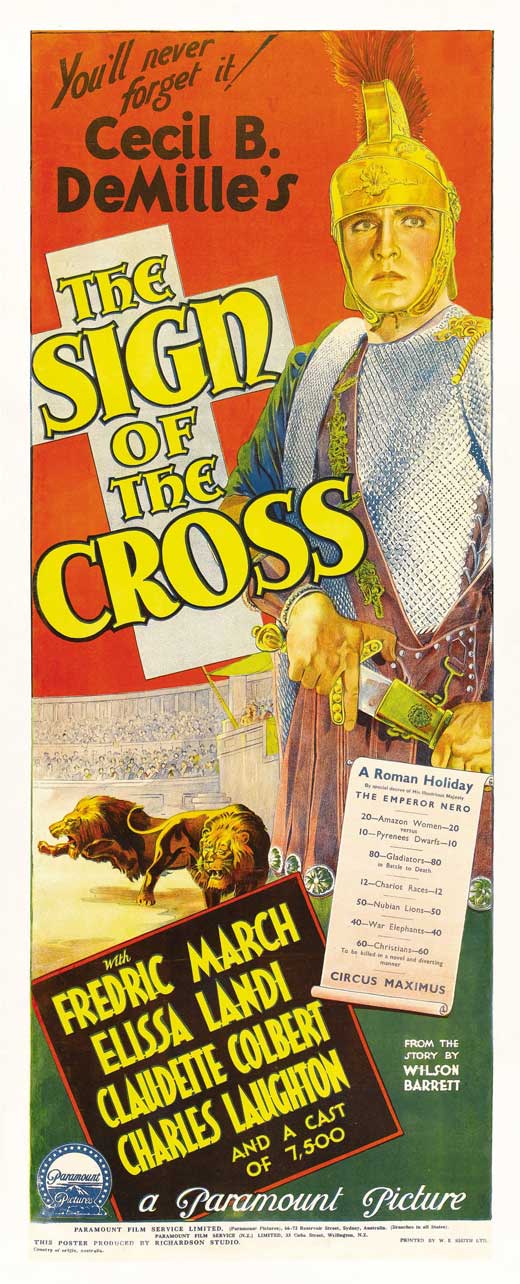
The Sign of the Cross (1932)
_01.jpg)
via doctormacro
On the one hand, you have the Christians, or Xians if you want to be more extreme. They seem nice enough people, young and old, a bit bellow the poverty line; all they really want to do is hang out together in secret meetings to sing the praises of peace, love, and Jesus. Then along comes the pesky intolerant Romans, who shoot arrows at the worshippers and send them to the colosseum. There, they face being squished by elephants or eaten by crocodiles and lions, in between the acts involving boxing, gladiators and women battling pigmies.
The pagan Roman nobles, which populate this film, by comparison, have it great! Parties all the time, all the grapes one can gobble, with more sexy bisexual prostitutes than you can shake a stick at (all right, you only see one, but there has to more out there in ancient Rome). Add Claudette Colbert (as Nero's horny wife Pomepea) bathing in the milk of donkeys, and you know that they are always having a grand old time.
_03.jpg)
via doctormacro
Why the film's hero, Prefect Marcus Superbus (Fredric March, looking very superb in a short tunic and perm), should convert in the end and join his pious Xian girlfriend (Elissa Landi) in being lion chow, is a little perplexing. He enjoys having fun with his fellow Romans, enjoying life and not giving a damn what the next day will bring. In comparison to that, the Xians are the ultimate party poopers, preferring to talk of salvation and not partake in more sinful delights.
So After spending more than 2 hours seeing him having a ball chilling with his pagan pals and getting chummy with Colbert, it's a bit of a shock for him to give it all up to convert literally minutes before the fateful gate opens. Then again, in addition to having an admittedly to a cute uplifting final shot, the entire film is supported by lovely decor and costumes, and populated by the always enjoyable March, Colbert, and Laughton, I carry more praise than disinterest towards it.
While I doubt that the film ever succeeded in converting anyone besides Marcus Superbus, it sure as hell provides a good, pre-code, sometimes head-straching entertainment.
Thursday, June 6, 2013
The Eagle and the Hawk (1933)
The early 30's were a good time for World War 1 flix: All Quiet on the Western Front (1930), and Journey's End (1930) showed that war was hell in the trenches, while Hell's Angels (1930), The Dawn Patrol (1930), and today's film take to the air to get their messages across. The latter type of films also had the added bonus of lacking the explicit gore and grungy claustrophobia of it's ground-based counterparts, making sure to intersperse the somber musings with thrilling areal dogfights.
This conflict of interest, to paint a despairing portrait of wartime, while at the same time providing entertainment, figures heavily into the plot of the unfortunately little-known The Eagle and the Hawk. Polo-playing Jerry Young (Fredric March) and working-man Henry Crocker (Cary Grant) are flyboys in France, whose missions consist of taking pictures of enemy areas, and attempting to evade enemy aircraft. While cynical Crocker remains grouchely somber about the whole affair, Young's naive idealism is unable to handle the brutality that surrounds him.
Though he is a talented flyer, he quickly losses a number of tailgunners in a short period of time. When Crocker becomes his newest replacement, the cleft-chins butt heads. But as Grant keeps his head, March slowly breaks from the strain of having his gunners drop like flies. who becomes something of a hero after flying numerous successful missions, slowly breaks from the strain
With a running time that's a little under 70 minutes, there is little time for padding, including romantic liaisons. A glitzy Carole Lombard, drowning in the fur collar of her coat, shows up for about 5 minutes as an understanding woman March meets on leave. She's okay, but it's March and Grant who are really stellar. While the mean-streaks and the hardheadedness of his character may put off some fans, his grudgingly growing mothering devotion to March reveal a more empathetic interior. Heck, I found him to have more chemistry with the leading man than with some of his leading ladies!

March, on the other hand, has a more obviously showy role as the solider growing in depression and desperation. He manages, as usual, to pull it off with great panache, managing to contain his despair enough to function, but not enough to allow him to move onward from his feelings of guilt and inadequacy when it comes to the death of his men. Overtime, however, he is unable to even accomplish that, leading up to a confessional dinner scene that is a bit reminiscent of his drunken.
The strangely affecting bromance between the doomed hero that can barely keep himself together and the forgotten man who's too aware of that is just one of the many moving aspects of this film. The gorgeous cinematography, well-paced story, and great performances from the leads render this to be a near-great ant-war movie.
This conflict of interest, to paint a despairing portrait of wartime, while at the same time providing entertainment, figures heavily into the plot of the unfortunately little-known The Eagle and the Hawk. Polo-playing Jerry Young (Fredric March) and working-man Henry Crocker (Cary Grant) are flyboys in France, whose missions consist of taking pictures of enemy areas, and attempting to evade enemy aircraft. While cynical Crocker remains grouchely somber about the whole affair, Young's naive idealism is unable to handle the brutality that surrounds him.
Though he is a talented flyer, he quickly losses a number of tailgunners in a short period of time. When Crocker becomes his newest replacement, the cleft-chins butt heads. But as Grant keeps his head, March slowly breaks from the strain of having his gunners drop like flies. who becomes something of a hero after flying numerous successful missions, slowly breaks from the strain
With a running time that's a little under 70 minutes, there is little time for padding, including romantic liaisons. A glitzy Carole Lombard, drowning in the fur collar of her coat, shows up for about 5 minutes as an understanding woman March meets on leave. She's okay, but it's March and Grant who are really stellar. While the mean-streaks and the hardheadedness of his character may put off some fans, his grudgingly growing mothering devotion to March reveal a more empathetic interior. Heck, I found him to have more chemistry with the leading man than with some of his leading ladies!
Decieteful VHS cover art: Lombard shares the box with Grant, and with no March in sight, makes it seem that there will be a love story involved (ala Wings or Hell's Angels)
The strangely affecting bromance between the doomed hero that can barely keep himself together and the forgotten man who's too aware of that is just one of the many moving aspects of this film. The gorgeous cinematography, well-paced story, and great performances from the leads render this to be a near-great ant-war movie.
Sunday, June 2, 2013
Alvarez Kelly (1966)
I usually have a very good memory when it comes to movies I've watched, especially ones that bring out strong feelings, be they good or bad. I saw this flick about a year ago, and from what I can recollect, it was definitely the latter.
I was in a Richard Widmark phase at the time, and when I found out about the existence of this film, my thought process went approximately like this: Oooo, Richard Widmark WITH AN EYEPATCH! And he battles with William Holden (one of my favorite actors) during the Civil War! And it's directed by Edward "Murder My Sweet, Crossfire, Warlock, The Sniper" Dmytryk. HOW COULD THIS NOT BE AMAZING?!
Alas, I was proved wrong. This film is forgettable; Amazingly, incredibly forgetable. I can recollect what happened, but much of it was so inane, that it's hardly worth repeating. Okay, I lie, it is (no wiki-synopsis-cheating for this recounting):
There's a gang of starving Confederate soldiers, lead by eyepatch Widmark, and they're after a bunch of cows. Holden is a legendary cow-handler, and though he dislikes the mission, Widmark persuades him to help out by shooting off a finger. Oh, and there are a couple of women scattered around, but they're mostly there to prevent the film from transforming into a sausage-fest and illustrate Holden's talent with the ladies, one of whom is Widmark's sexually unsatisfied fiancee, who flees northward with Holden's help, after he gives her some good (fade-out) lovin'.
Remember, this film's plot is hinged on kidnapping cows. Cows. Let that sink in. If you think that it sounds enduringly quirky, think again. With the exception of the previously stated finger-shooting scene (which is admittedly intense), and another where Widmark laughs his ass off non-stop for thirty seconds (which is, admittedly, pretty funny), this was a very listless, workman-like film. Visually and script-wise, there's barely anything eye-catching or even particularly interesting about the affair. It saddens me to imagine the blown potential,what with the eye-patch and all. Oh movies, you never sease to amaze me.
I was in a Richard Widmark phase at the time, and when I found out about the existence of this film, my thought process went approximately like this: Oooo, Richard Widmark WITH AN EYEPATCH! And he battles with William Holden (one of my favorite actors) during the Civil War! And it's directed by Edward "Murder My Sweet, Crossfire, Warlock, The Sniper" Dmytryk. HOW COULD THIS NOT BE AMAZING?!
Alas, I was proved wrong. This film is forgettable; Amazingly, incredibly forgetable. I can recollect what happened, but much of it was so inane, that it's hardly worth repeating. Okay, I lie, it is (no wiki-synopsis-cheating for this recounting):
There's a gang of starving Confederate soldiers, lead by eyepatch Widmark, and they're after a bunch of cows. Holden is a legendary cow-handler, and though he dislikes the mission, Widmark persuades him to help out by shooting off a finger. Oh, and there are a couple of women scattered around, but they're mostly there to prevent the film from transforming into a sausage-fest and illustrate Holden's talent with the ladies, one of whom is Widmark's sexually unsatisfied fiancee, who flees northward with Holden's help, after he gives her some good (fade-out) lovin'.
Remember, this film's plot is hinged on kidnapping cows. Cows. Let that sink in. If you think that it sounds enduringly quirky, think again. With the exception of the previously stated finger-shooting scene (which is admittedly intense), and another where Widmark laughs his ass off non-stop for thirty seconds (which is, admittedly, pretty funny), this was a very listless, workman-like film. Visually and script-wise, there's barely anything eye-catching or even particularly interesting about the affair. It saddens me to imagine the blown potential,what with the eye-patch and all. Oh movies, you never sease to amaze me.
Subscribe to:
Posts (Atom)